
The Pot of Gold at the End of the Rainbow
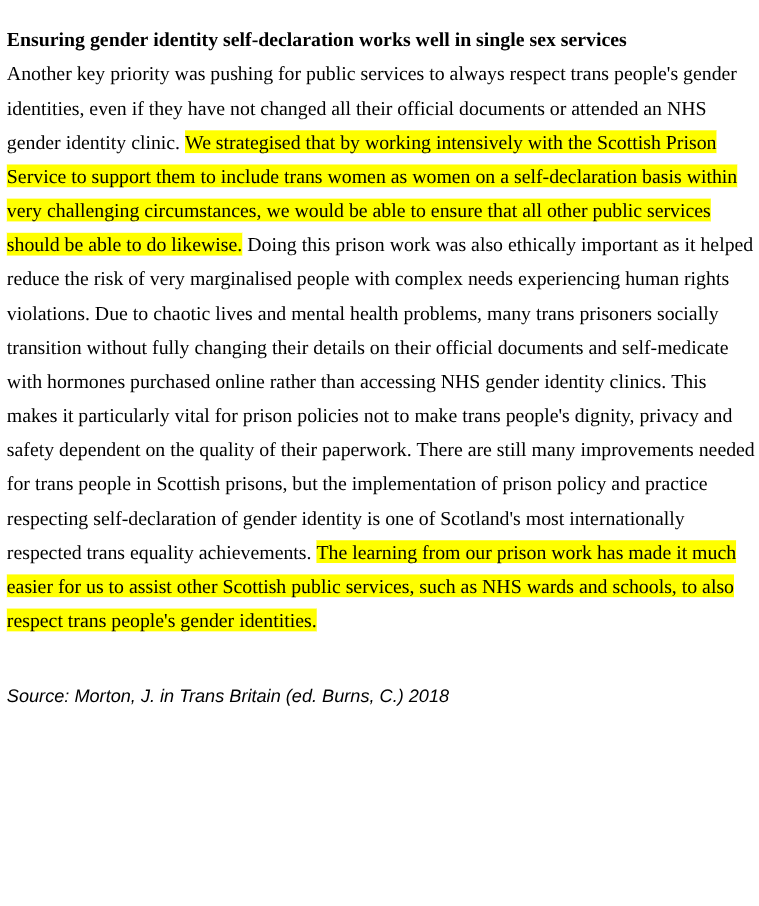
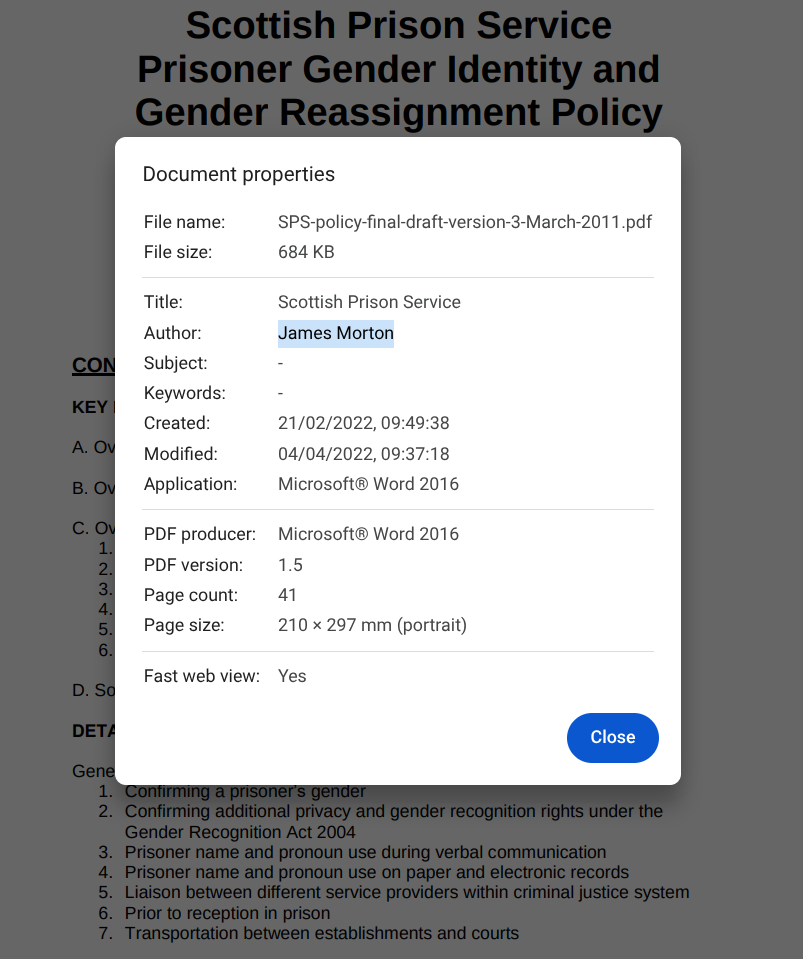
On the 19th of June we won a judicial review on the Scottish Prison Service’s transgender policy which allowed males to be accommodated in the female prison estate. The unlawfulness of this policy should have been blindingly obvious following the UK Supreme Court decision that sex is biological and separate provision for women necessarily excludes all men. The Scottish Government went above and beyond any rational response in order to defend a policy that has remained largely unchanged since it was first introduced in 2014 at the bequest of James Morton of Scottish Trans Alliance. Morton “strategised” that introducing a policy of placing prisoners in the estate matching their self-declared sex would ease the way for doing likewise in NHS wards and schools.
By the time Scottish Trans was invited into Parliament in 2016 to present its campaign on reform of the Gender Recognition Act, James Morton was keen to conclude that self-declaration of sex was working well in prisons and hospitals. Committee members paid scant regard to any impact on women, and it’s painfully clear that no opposing voices to the campaign were heard.
“We’ve worked for several years now with the Scottish Prison Service, in partnership with them very successfully. They take a self-declaration approach. If somebody identifies and lives as female, then they would treat them as a female in the custodial process, do individualised risk assessment to place them and supervise them appropriately within the female estate.”
James Morton, Scottish Parliament, Equal Opportunities Committee – 04 February 2016
The full session is available on video or in the Official Report.
Reform of the Equality Act was also discussed with Morton reiterating Scottish Trans’ previous call to Westminster to remove the single-sex exceptions in the Equality Act. No-one pushed back on this proposal, or so much as raised an eyebrow at the announcement that women’s organisations were casually abusing the genuine occupational requirements by basing it on self-declaration of sex – Mridul Wadhwa was working for Shakti Women’s Aid at this point.
“We would like to see the removal of the exceptions that currently exist [in the Equality Act]. An employer that only hires women can refuse to hire a transwoman…we think that that’s not appropriate…using that exception is wrong and unfair.”
Years of unquestioningly following poor advice from Scottish Trans (which is the “project” of the registered lobby group Equality Network) has proved to be humiliating and costly for the Scottish Government. The success of the campaign to reform gender recognition ended with the Act blocked from becoming law by the UK Government on the grounds that it interfered with the Equality Act 2010, which is reserved legislation. The Ministers resoundingly lost the ensuing legal challenge. The prison policy was ruled unlawful, breaching both the Prisons and Young Offenders Institutions (Scotland) Rules 2011 and the Equality Act. The Scotland Act has been treated as optional rather than fundamental constitutional law. And of course, the legislation that kick-started our series of judicial reviews – the Gender Representation on Public Boards (Scotland) Act 2018 and its accompanying statutory guidance – incorporated the amendment proposed by Scottish Trans that “transwomen are women” with or without a gender recognition certificate. Both were found to be unlawful.
“Within the idea of increasing representation of women on public boards we think that it needs to be very clearly inclusive of transwomen…We propose that for the avoidance of doubt [the bill] should say that the definition of “woman” includes a person with the protected characteristic of gender reassignment who is living in the female gender.”
James Morton, Scottish Parliament, Equalities and Human Rights Committee – 05 October 2017
The full session is available on video or in the Official Report.
The Supreme Court ultimately ruled the Equality Act was founded on sex as a binary, unchangeable, biological fact. Quite frankly, from start to finish it has been an unmitigated disaster for the Scottish Government with costs to the public purse in excess of £1.3 million pounds, with an award for our legal expenses in the prisons case still pending.
Meanwhile, Equality Network has faced no consequences and continues to enjoy generous grants funded by the taxpayer and unparalleled access to Scottish Ministers. It was first funded by the Scottish Government in 2002 with a grant of £46,097. Within two years this more than tripled and, by the time Equality Network’s latest accounts were published (for the year ending March 2025), it was in receipt of £558,711, which amounted to a whopping 91% of its total annual income.
But who is the puppet and who is pulling the strings? It’s hard to tell if the Scottish Government is doing the bidding of Equality Network or if Equality Network is happily pushing forward the policy aims of Government. After all, the Scottish Ministers proudly informed the court back in 2020 that “transwomen are women” was a longstanding Government policy.
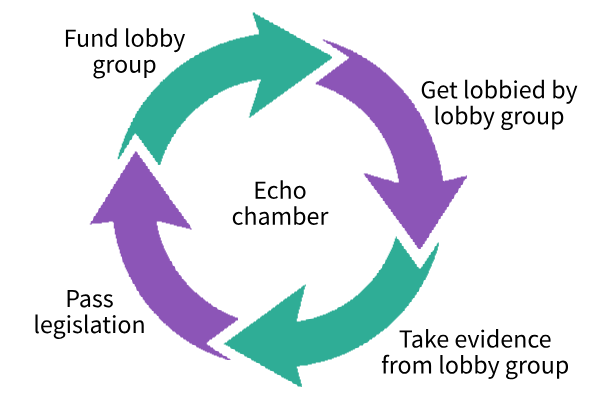
Either way, this co-dependent relationship is clearly no longer a mutually beneficial echo chamber. Women – and the courts – have finally broken through and a wiser government would recognise how out of touch it has become with ordinary voters, and not simply move to reinforce the barricades.
It was with some considerable interest then, that we watched the Scottish Government led debate in Parliament about strengthening the Government’s partnership with third sector organisations.
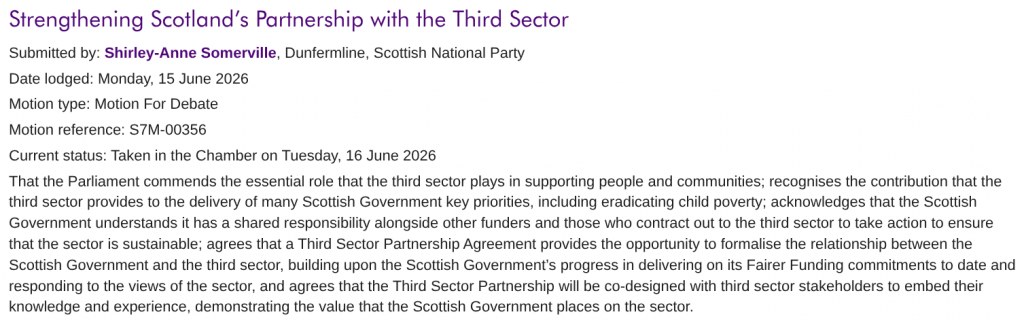
Stephen Kerr MSP raised the issue of almost wholly-funded lobby groups that pose as charities to help push Government agenda. He mentioned The Times article How the SNP spends billions ‘to buy loyalty from charities’ in which former SNP minister Alex Neil confirmed “the administration would regularly ask “friendly” charities to support it publicly with controversial policies”. He now believes there should be an independent investigation into the relationship between the devolved government and the charity sector, saying “[T]here are some, within certain sectors, which have too cosy a relationship with the government.”
The full debate is available on video or in the Official Report.
Mr Kerr expressed the frustration of many: “For years, my office has tried to follow the money. We have submitted parliamentary questions, pursued freedom of information requests and trawled through annual reports. It should not be that difficult to establish where taxpayers’ money is going, yet there is no single source of information. There is no straightforward way for parliamentarians, journalists or taxpayers to understand who receives public funds, how much they receive and what they spend it on.”
Shirley-Anne Somerville, speaking for the Government, defended its position, emphasising a commitment to “fairer funding” to provide transparency of grant awards and multiyear funding. This would ensure “accountability at all levels”, and she pledged this work would be “rooted in trust and respect” and that “questioning the integrity of the third sector erodes trust”.
It’s almost like Ms Somerville is living in cloud cuckoo land. Two of the main Government funds for women’s and LGBT organisations are the Equality and Human Rights (EHR) Fund and the Delivering Equally Safe (DES) Fund. Administration of both funding streams is contracted out to Inspiring Scotland, who are conveniently beyond the reach of Freedom of Information enquiries. We’re not even allowed to know how much it is paid to perform a task that would ordinarily be well within the remit and capabilities of government officials.
Inspiring Scotland started managing these two funds in 2021, which was the first and last time organisations could bid for grants. This initial funding was for a three year period, but in 2024, 2025 and 2026 the annual grant was simply rolled over to the same organisations, no questions asked. Which is fine for the lucky 47 grant recipients of 2021, but not so good for the remainder of the 242 original applicants who were rejected and have since been denied any opportunity to reapply, for example, Govanhill Law Centre future in doubt as Scottish government refuses funding. We simply don’t know how many worthy projects have fallen by the wayside, or the number of new organisations, such as Scottish Rape Crisis Alliance, that may have benefited from open applications. It is not a level playing field.
In December 2025, Ash Regan MSP asked what decision-making processes governed the automatic rollover of grant awards, but the question was deflected and no explanation given. The only information forthcoming was that decisions on grant funding for 2026-27 would be announced following the passing of the 2026 Budget Bill but, of course, by that time it would be far too late to invite open applications for a funding period due to start only four weeks later.
Contrary to promises of transparency and accountability by Somerville, it is clear the inexplicable decision to rollover grant awards for yet another year was made behind closed doors by persons unknown and for reasons yet to be disclosed, long before the budget passed on 25th February. Freedom of information responses confirm this fact. Provisional offers of funding were sent to existing grant recipients as early as 16th January thereby ruling out the possibility of re-opening the funding streams to other third sector groups. Subsequently, “in light of the 2026-27 offer” at the same “flat funding level”, Equality Network submitted a reprofile form date stamped 19th February.
All of which makes it ridiculously absurd, and patently untrue, that the EHR fund managers at Inspiring Scotland claimed not to know on 26th February if the fund was going to open for new applications this year. It’s inconceivable they were unaware of the automatic rollover whilst already processing the paperwork for the same grants.
The public announcement about grant decisions that Someville promised Ash Regan failed to materialise and, despite it now being over three months into the new funding period, searches of both the Scottish Government and Inspiring Scotland websites turn up little of substance. Only a passing comment buried in the minutes of a human rights working group, published in June, confirms grants were rolled over to the same recipients as before. No justification is given anywhere, and the public remain unaware of who got what money, and for what purpose.
Incidentally, it is very hard for the Scottish Government to maintain the illusion that third sector organisations are independent and free to challenge Government policies when it appears that Government sets out the draft objectives of Equality Network and classifies them as the formulation of Government policy.
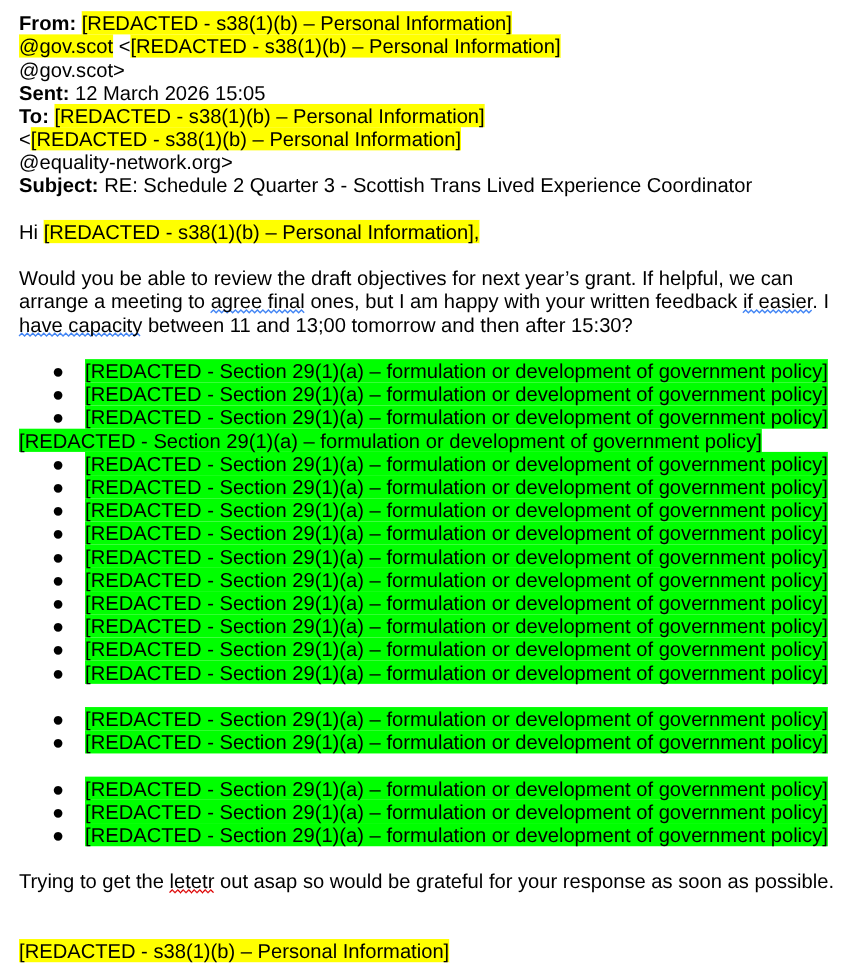
There was never any doubt that Equality Network’s grant, and that of other favoured activist groups, was ever in jeopardy or would even be subject to scrutiny via open competition. The public purse has been wedged wide open for 25 years – now that’s real “multiyear” assured funding – to the tune of approximately £9.2 million in Government grants to Equality Network (excluding other public monies sourced from the NHS and local authorities). The EHR and DES funds distribute around £33 million to third sector organisations every year.
Decisions on taxpayers’ sums of this magnitude should be fully transparent and decision-makers willing to be held accountable. Outsourcing fund management to Inspiring Scotland severely hobbles accountability, it is itself complicit in protecting those who fund it, and there is little reassurance of capability in dealing with improper lobbying and misrepresentation of the Equality Act by fund recipients. Funding for organisations that advise the Government to break the law in the egregious manner repeatedly demonstrated by Equality Network should have been terminated long ago. A failure to do so, and an ongoing willingness by the Scottish Government to seek yet more poor advice at the expense of better informed individuals and groups, represents a serious democratic failure operated through the use of this fund. The sunk-cost fallacy shows no signs of wavering.
When Parliament reopens in September it should therefore come as no surprise to see another doomed piece of legislation enthusiastically proposed hand-in-hand by Government and its lobbyists, one that has been cooked up in private and, if passed in its current form, will no doubt be heading to the Court of Session.
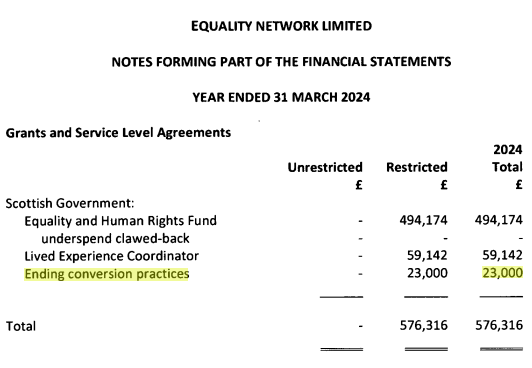
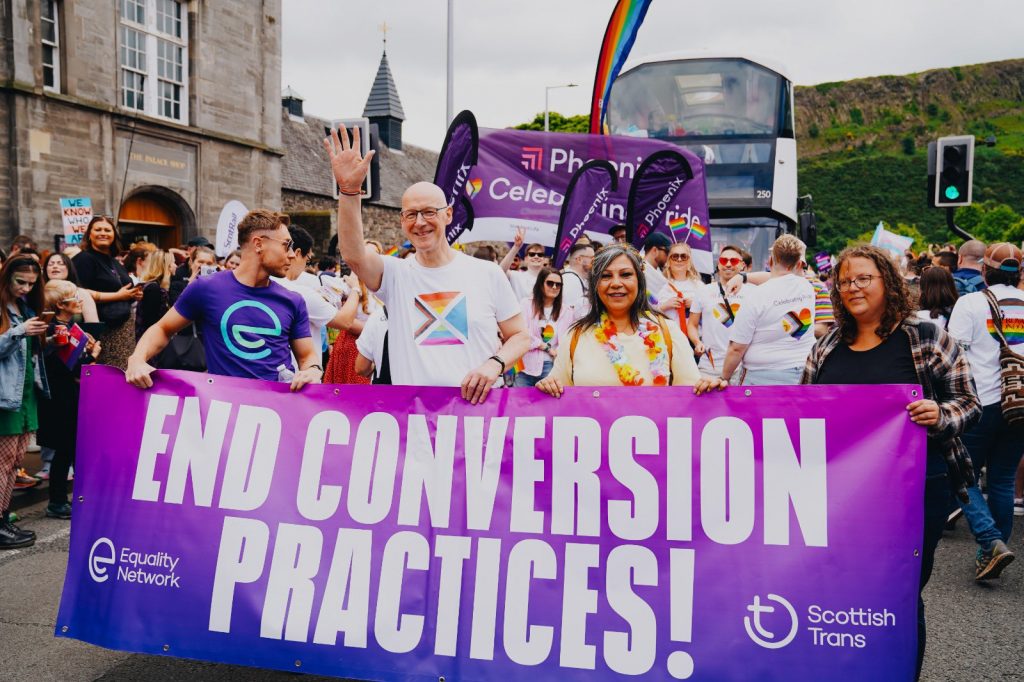
Members of the public should not need to go on a treasure hunt via lengthy Freedom of Information enquiries to discover how our money is being spent. But since the Scottish Government has failed to publish information about grants under the EHR and DES funds, the following is what has so far been winkled out of a reluctant and failing system.
Equality and Human Rights Fund – organisations funded under the protected characteristic “sex”:
Organisation | 2026 – 2027 | Total funding: Oct 2021 – Mar 2027 |
|---|---|---|
| Amina – Muslim Women’s Resource Centre Grant offer letter I Profile update I Grant Offer Terms | £207,019.00 | £1,138,098.50 |
| Close the Gap Grant offer letter I Profile update I Grant Offer Terms | £226,540.00 | £1,237,240.00 |
| Elect Her Grant offer letter I Profile update I Grant Offer Terms | £100,048.00 | £552,923.00 |
| Engender Grant offer letter I Profile update I Grant Offer Terms | £553,655.00 | £2,157,678.00 |
| Equate Grant offer letter I Profile update I Grant Offer Terms | £355,626.00 | £1,903,971.50 |
| Glasgow Women’s Library Grant offer letter I Profile update I Grant Offer Terms | £125,056.00 | £685,366.50 |
| Kairos Women+ Grant offer letter I Profile update I Grant Offer Terms | £46,445.00 | £258,053.00 |
| Scottish Women’s Budget Group Grant offer letter I Profile update I Grant Offer Terms | £74,383.00 | £406,721.00 |
| Scottish Women’s Convention Grant offer letter I Profile update I Grant Offer Terms | £196,667.00 | £1,081,667.00 |
| YWCA Scotland Grant offer letter I Profile update I Grant Offer Terms | £144,652.00 | £769,867.00 |
| Totals | £2,030,091.00 | £10,191,585.50 |
Equality and Human Rights Fund – organisations funded under the category “LGBT“:
Organisation | 2026 – 2027 | Total funding: Oct 2021 – Mar 2027 |
|---|---|---|
| Equality Network Grant Offer Letter I Profile Update | £503,265.00 | £2,767,985.50 |
| LEAP Scotland Grant Offer Letter I Profile Update | £71,403.00 | £390,911.00 |
| LGBT Health and Wellbeing Grant Offer Letter I Profile Update | £189,932.00 | £1,024,091.00 |
| LGBT Youth Scotland Grant Offer Letter I Profile Update | £290,871.00 | £1,589,394.50 |
| Stonewall Grant Offer Letter I Profile Update | £106,505.00 | £582,606.00 |
| Totals | £1,161,976.00 | £6,354,988.00 |
Equality and Human Rights Fund 2026-27 (total fund: £9.9m) – full list of organisations and grant amounts:
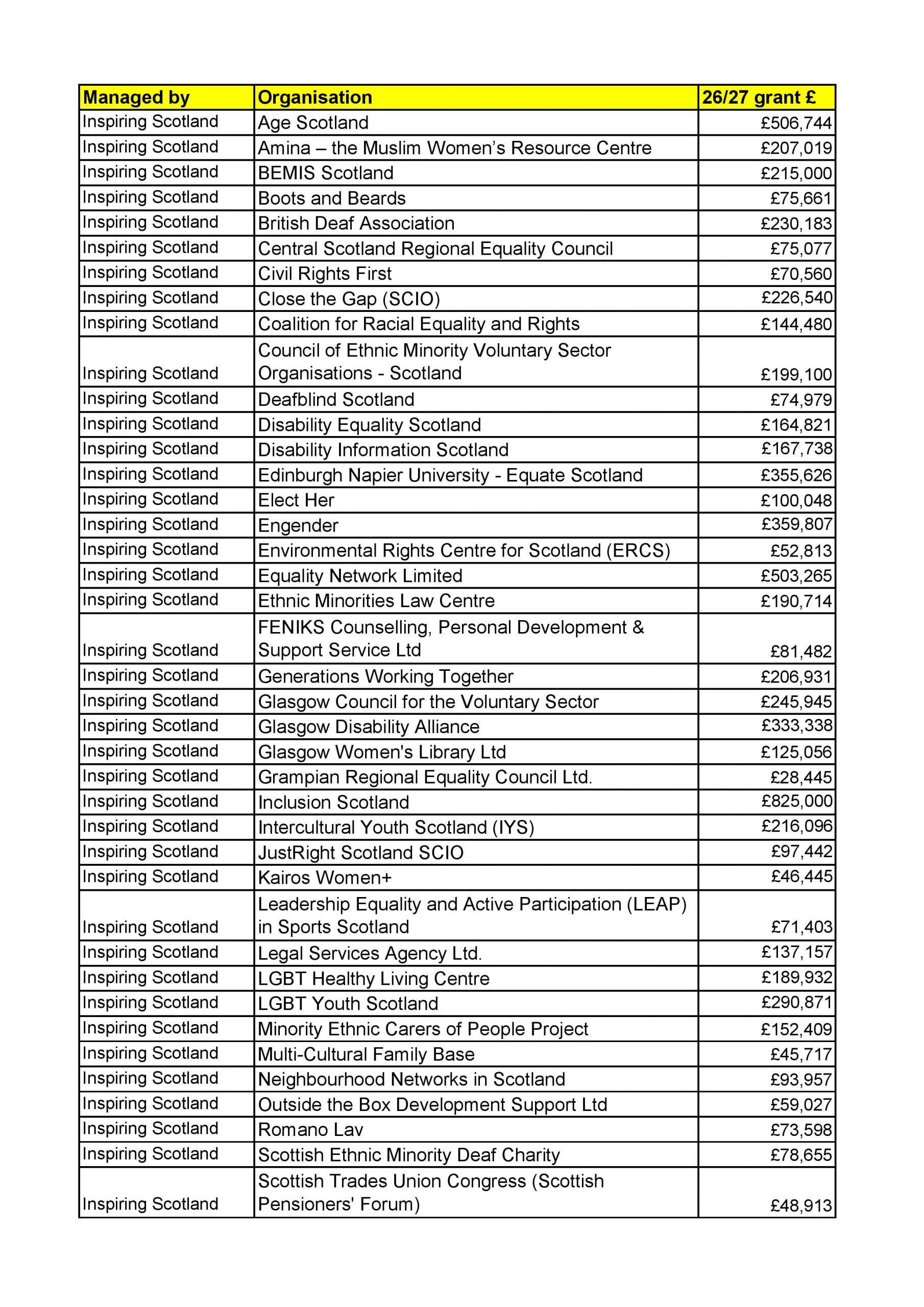
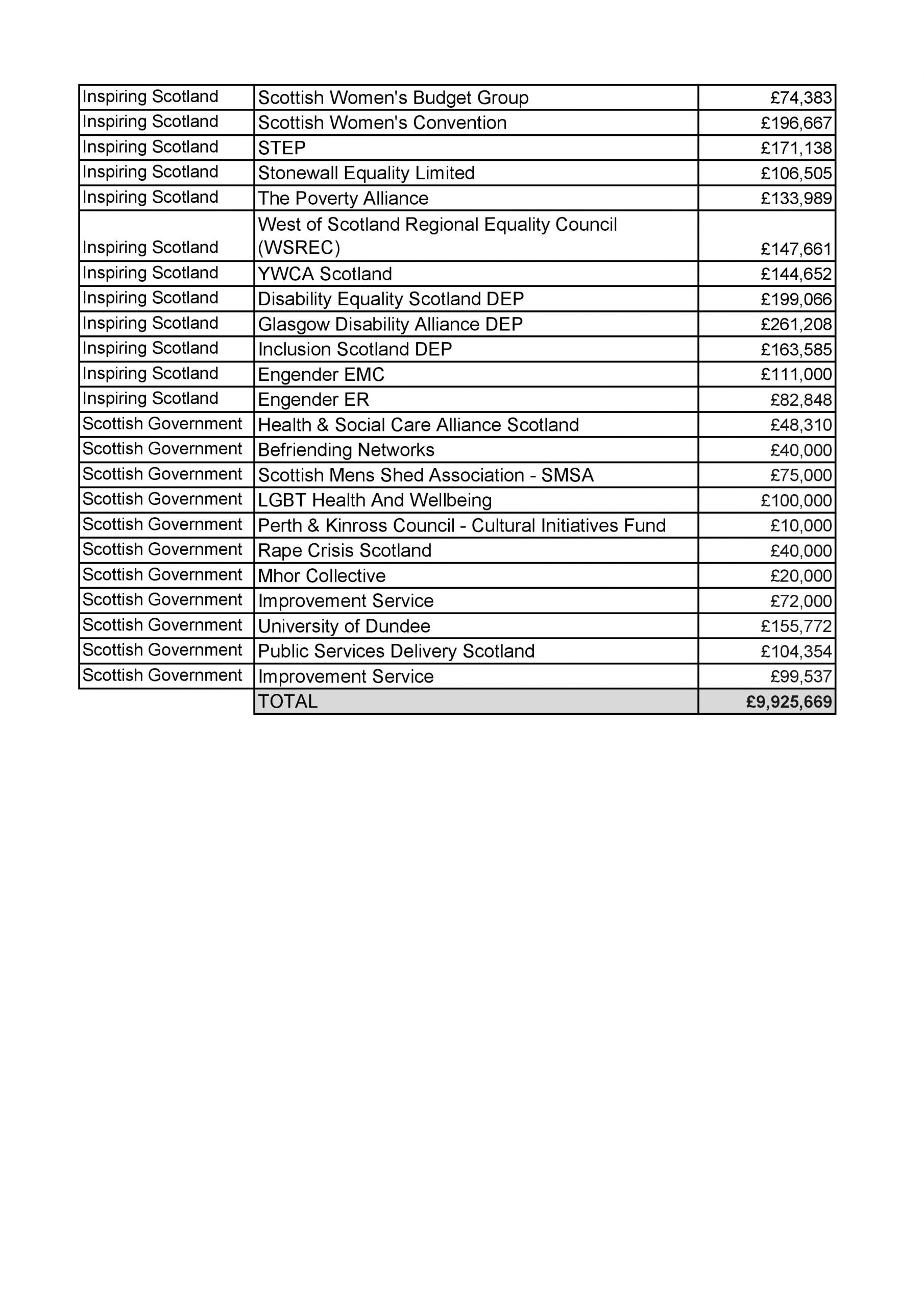
View as a PDF
Delivering Equally Safe Fund, 2026-27 – selected organisations:
Organisation | 2026 -2027 | Total funding: Oct 2021 – Mar 2027 |
|---|---|---|
| Close the Gap Grant Offer Letter I Grant Offer Terms | £190,568.00 | £946,680.50 |
| Edinburgh Rape Crisis Centre Grant Offer Letter I Grant Offer Terms | £480,305.00 | £2,358,385,37 |
| Engender Grant Offer Letter I Grant Offer Terms | £75,186.00 | £371,050,42 |
| Glasgow and Clyde Rape Crisis Centre Grant Offer Letter I Grant Offer Terms | £734,457.00 | £2,990,467.52 |
| Just Right Scotland Grant Offer Letter I Grant Offer Terms | £43,867.00 | £214,082.09 |
| LGBT Youth Scotland Grant Offer Letter I Grant Offer Terms | £58,562.00 | £286,275.00 |
| Rape Crisis Scotland Grant Offer Letter I Grant Offer Terms Rape Crisis Scotland – Partnership Grant Offer Letter I Grant Offer Terms | £1,592,414.00 | £4,710,051.86 |
| Sacro Grant Offer Letter I Grant Offer Terms | £212,966.00 | £1,044,928.30 |
| YWCA Scotland Grant Offer Letter I Grant Offer Terms | £31,970.00 | £156,980.34 |
| Zero Tolerance Grant Offer Letter I Grant Offer Terms | £320,069.00 | £1,556,744.00 |
Delivering Equally Safe Fund (total fund: £23m) – full list of organisations and grant amounts
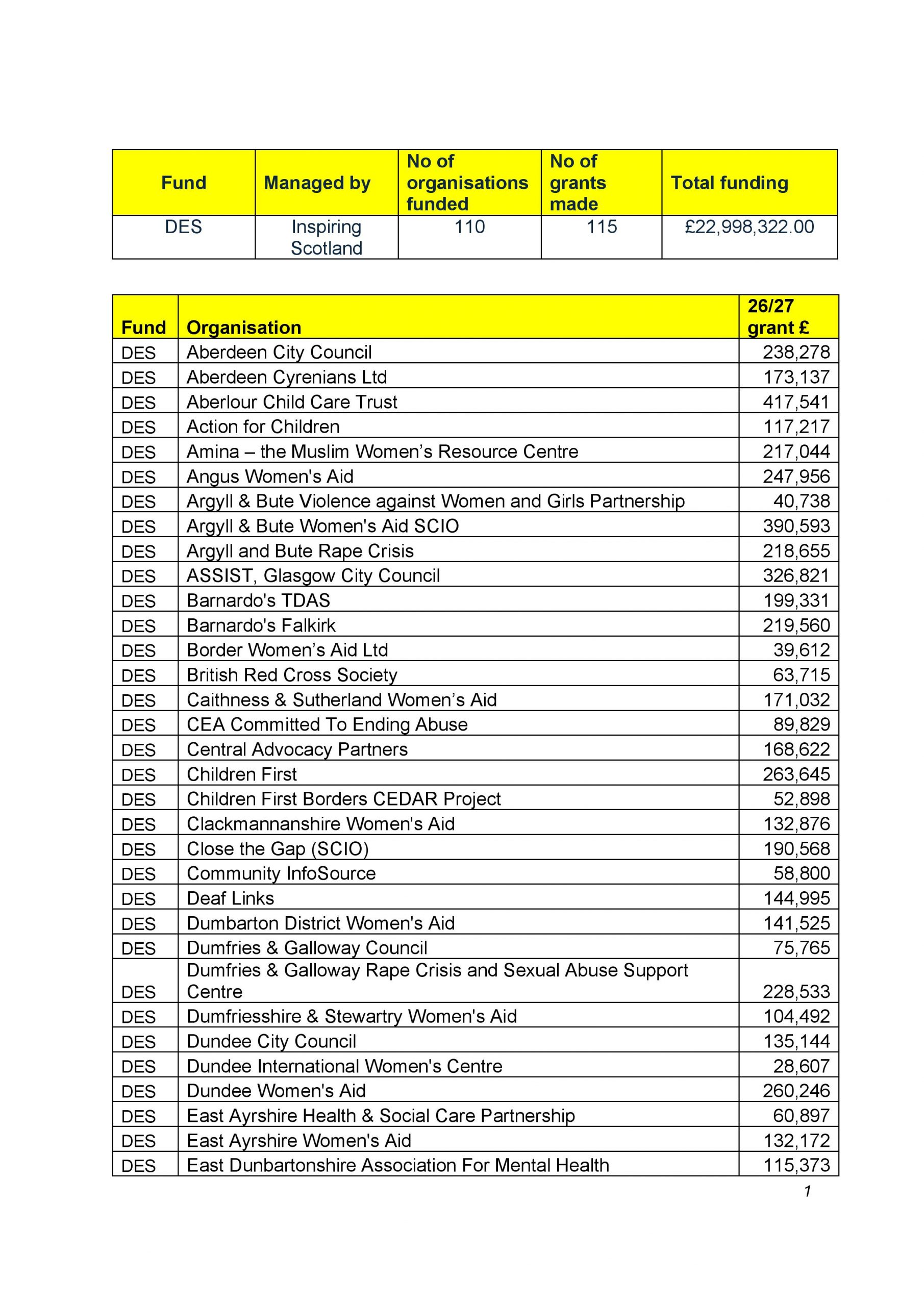
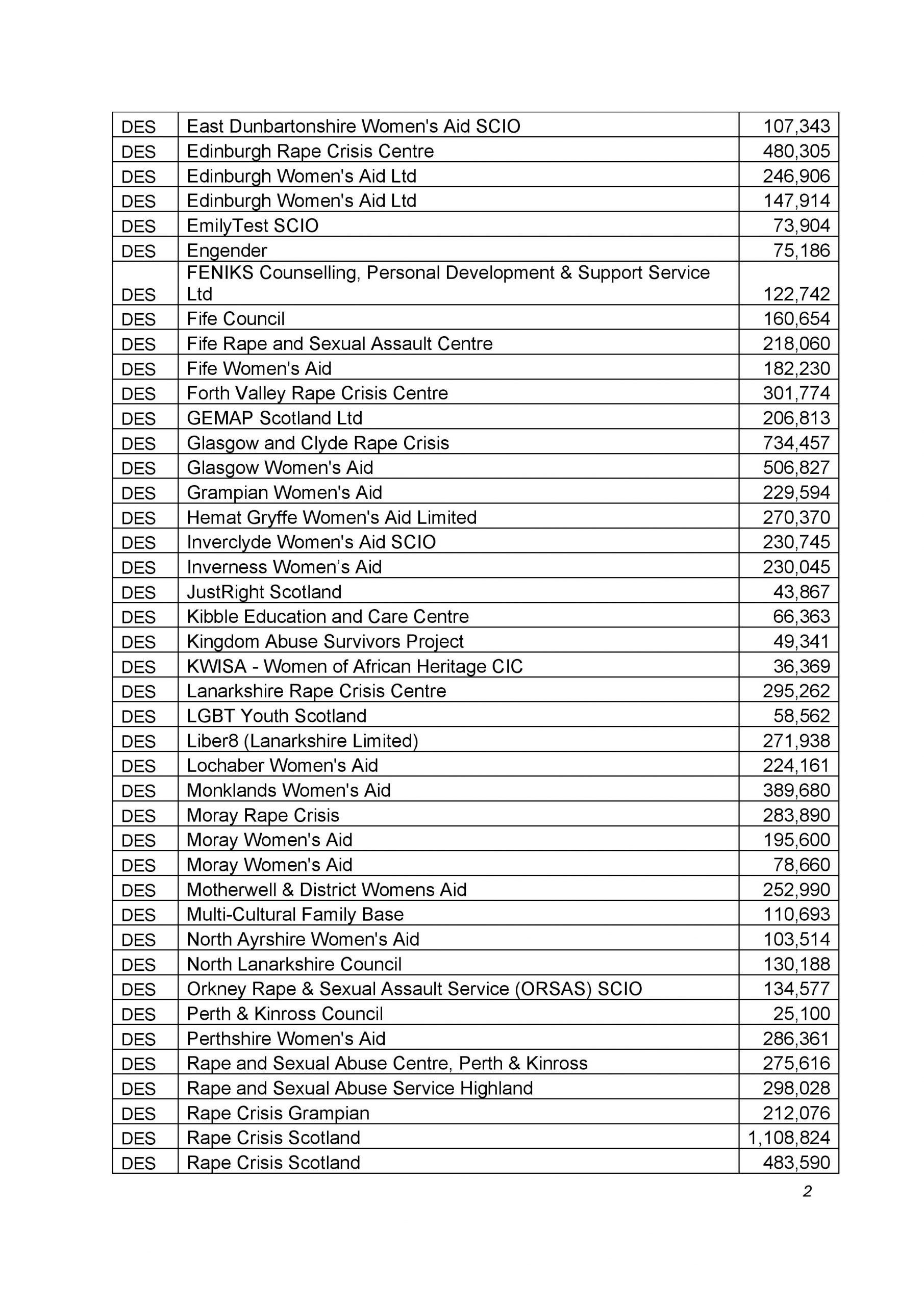
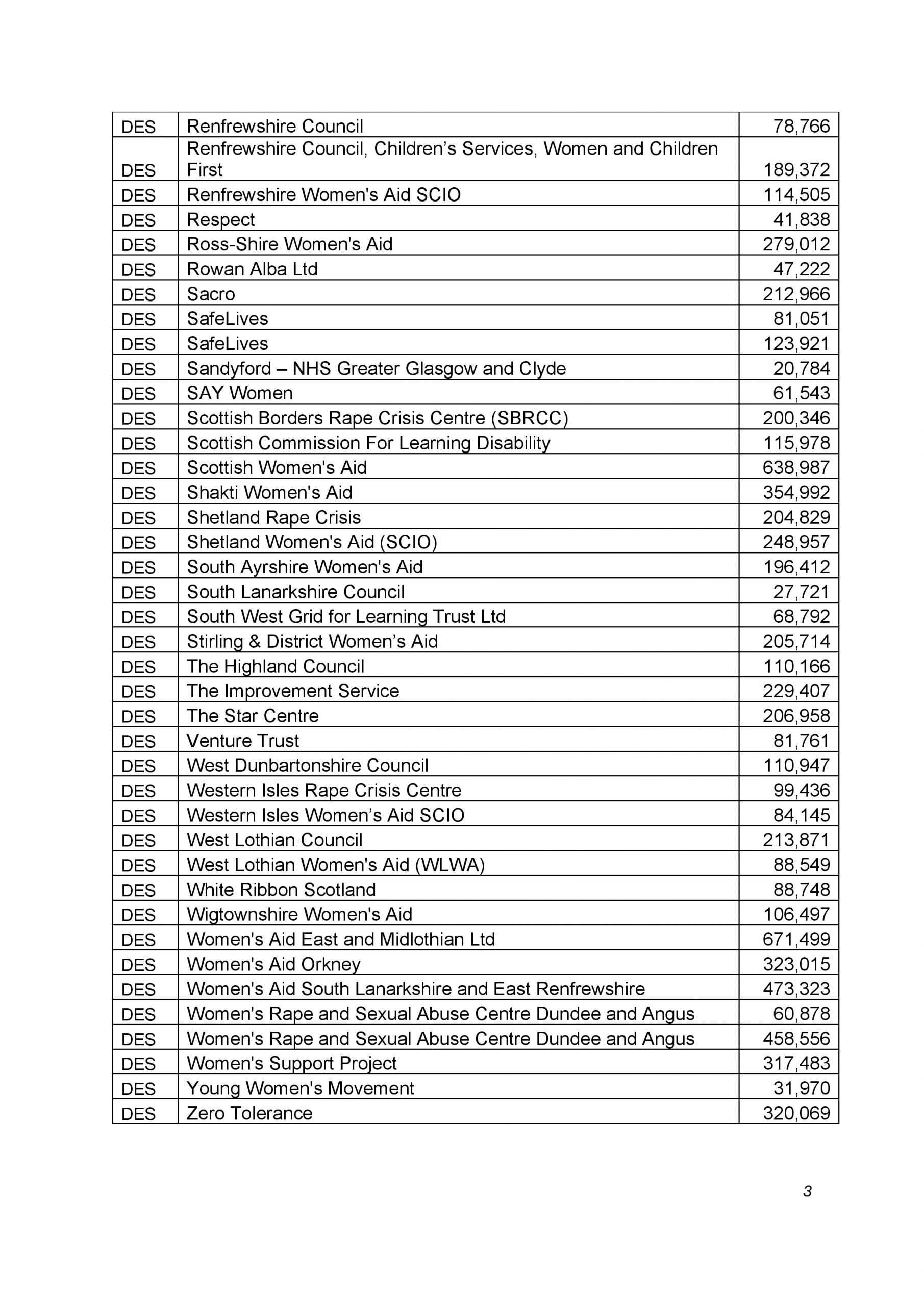
View as a PDF
It is noticeable that the umbrella organisation Rape Crisis Scotland enjoyed a 5% increase in Government grants since last year, despite a number of members breaking away in early 2026 to form their own women-only organisation, Scottish Rape Crisis Alliance. SCRA represents over 40% of Scotland’s female population, across 12 of Scotland’s 32 local authority areas, yet was denied the opportunity to apply for DES funding. It remains unclear whether RCS retains the full funding or has redistributed the proportion SCRA’s rape crisis centres would formerly have been allocated.