
It only applies to the Equality Act…
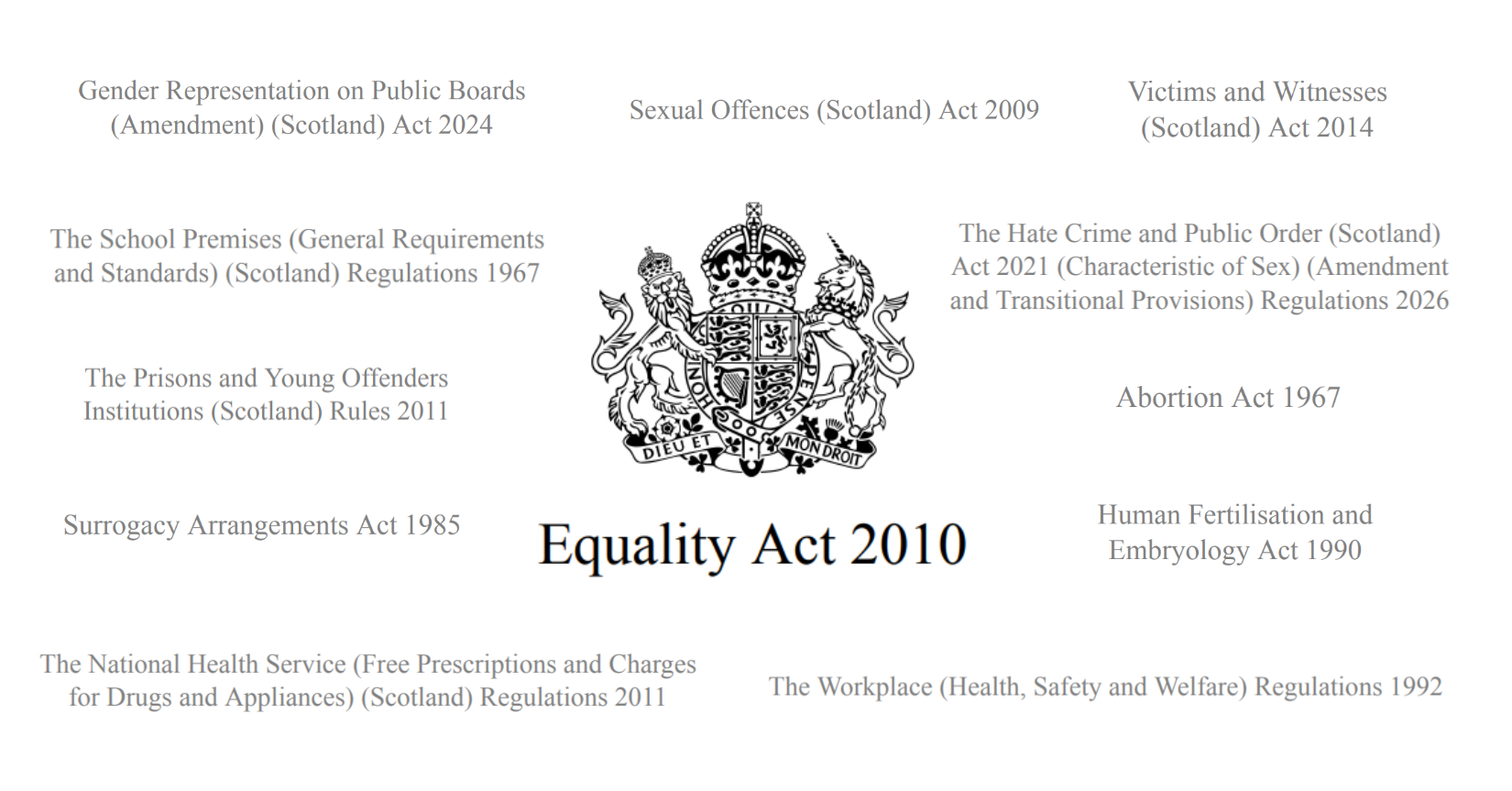
…said no-one who has actually read the UK Supreme Court judgment in For Women Scotland v Scottish Ministers. Which is perhaps why Equality Network, among many others, has foolishly and frequently uttered those very words.
“The ruling had no impact on the meaning of sex in any other legislation”
“The court’s interpretation of ‘sex’ was based on the specific wording and application of the provisions of the Equality Act 2010, and it applies only to that Act. It has no implication for, not does it impose any legal restriction on, the meaning of ‘sex’ in other legislation. And in fact it remains the case that section 9 of the Gender Recognition Act 2004 (GRA) specifies that ‘sex’ means what the Supreme Court termed “certificated sex” for all purposes, except those where that meaning is specifically disapplied.”
While it is true that the Supreme Court’s decision concerned only the matters before it ie. the meaning of the terms “sex”, “man” and “woman” in the Equality Act 2010, the extent of the Gender Recognition Act 2004 to those terms, and the lawfulness of the statutory guidance for the Gender Representation on Public Boards (Scotland) Act 2018, it only arrived at its decision after applying a legal test. This test is described in paragraph 160 of the judgment:
If the EA 2010 can only be read coherently to mean biological sex, the same result must follow. The question that must therefore be answered is whether there are provisions in the EA 2010 that indicate that the biological meaning of sex is plainly intended and/or that a “certificated sex” meaning renders these provisions incoherent or as giving rise to absurdity. An interpretation that produces unworkable, impractical, anomalous or illogical results is unlikely to have been intended by the legislature.
The Supreme Court concluded that the biological meaning of sex was clearly intended by Parliament when it passed the Equality Act, primarily because key pregnancy and maternity provisions for women necessitates a biological understanding of sex [para 177], and that it made no sense for practical day-to-day sex based rights to be regulated by knowledge of who possesses a (confidential) certificate [para 173].
Paragraph 108 confirms the same legal test can be used to assess “the very many statutes referring to men and women”, whether they were enacted before or after the Gender Recognition Act 2004. This will determine whether the wording, context and policy of the statute in question refers to “certificated sex” (as per section 9(1) of the GRA) or biological sex (and therefore section 9(3) disapplies section 9(1)). Contrary to the assertions of Equality Network, it is not necessary for section 9(1) to be “specifically disapplied” by express wording in a statute – this argument was rejected by the court at paragraph 102.
Instead, the Supreme Court determined [para 156] that the GRA will not apply to a statute where the:
- terms, context and purpose show that a biological meaning of sex is intended, because of a clear incompatibility, or
- provisions are rendered incoherent or unworkable by the application of the rule in section 9(1).
This must be assessed case-by-case for each statute where terms are contested. It was not before the Supreme Court to do this work but, using the legal test provided, other courts have ruled on a number of statutes. In addition to the Equality Act, legislation that has been found to use sex as a biological term includes the following:
1. Gender Representation on Public Boards (Scotland) Act 2018
As enacted “woman” was defined as including “a person who has the protected characteristic of gender reassignment (within the meaning of section 7 of the Equality Act 2010) if, and only if, the person is living as a woman and is proposing to undergo, is undergoing or has undergone a process (or part of a process) for the purpose of becoming female.”
The statutory guidance that followed in 2020 expanded on this, stating:
To be included, a transwoman without a GRC must meet the following criteria:
- have the characteristic of gender reassignment as defined in the Equality Act 2010,
- be proposing to undergo, is undergoing or undergone a process (or part of a process) for the purpose of reassigning their sex to female, and
- be living as a woman.
This is the point at which we raised, and later won, a judicial review in the Court of Session and in due course the definition of woman in the Act was repealed by the Gender Representation on Public Boards (Amendment) (Scotland) Act 2024.
In 2022 the statutory guidance was amended to only include male GRC holders in the definition of women, which was ultimately found unlawful by the UK Supreme Court. A further amendment in June 2025 now clarifies that the Act refers to woman as a biological term:
“There is no definition of “woman” set out in the Act with effect from 19 April 2022 and 22 March 2022. By virtue of section 11 and section 212(1) of the Equality Act 2010. references in the Act to a “woman” or to “women” are references to a biological woman or women.”
2. Victims and Witnesses (Scotland) Act 2014 as amended by the Forensic Medical Services (Victims of Sexual Offences) (Scotland) Act 2021
Section 9(2) of the 2014 Act (as amended by the 2021 Act) specifies that before a forensic medical examination by a registered medical practitioner is to be carried out on a victim of a sexual assault, the person subject to this medical examination “must be given an opportunity to request that any such medical examination be carried out by a registered medical practitioner of a sex specified by the person”.
Before the amendment – which was the result of the “six words” campaign – the reference in the 2014 Act was to the “gender” of the registered medical practitioner.
Paragraph 159 of the UK Supreme Court judgment reaffirmed sex was biological in this Act:
“We agree with [the Outer House] analysis: sex as used in this provision must mean biological sex notwithstanding that there is no reference to biological sex in this provision. The clear statutory intention is to respect the right of a female or male victim of a sexual crime to request same sex care should she or he so wish because it has always been, and still is, well recognised that reasonable objection can be taken to an intimate medical examination by a member of the opposite biological sex. References to sex could only be references to biological sex in context.”
Still untested:
Unfortunately, Section 8(2) of the 2014 Act still specifies that before a police officer interviews a person who is the victim of an offence, the person must be given the opportunity to specify the gender of the investigating officer who is to carry out the interview. There was no opportunity when the 2021 Act was passing through Parliament to amend this section but, for exactly the same reasons as given by the Supreme Court, it is logical this was intended to respect the right of a victim to request an interviewer of the same sex when disclosing traumatic details of a sexual crime.
3. Workplace (Health, Safety and Welfare) Regulations 1992
Section 20 of the regulations state that sanitary conveniences shall not be suitable unless “separate rooms containing conveniences are provided for men and women except where and so far as each convenience is in a separate room the door of which is capable of being secured from inside”. Section 21 on washing facilities is in the same terms. And section 24 states that facilities to change clothing “shall not be suitable unless they include separate facilities for, or separate use of facilities by, men and women where necessary for reasons of propriety”.
We can thank the Good Law Project for clarifying that the biological definitions of men and women apply to the regulations. In their judicial review against the Equality and Human Rights Commission’s interim update, GLP argued that the Regs require no more than the provision of separate male and female facilities, but says nothing as to the manner in which those facilities should be used – thus a policy of allowing trans identifying men to use the women’s facilities would be lawful. The court rejected this submission, ruling that it placed “form over substance” and stated “It is clear from this that the objective of regulation 20 is that men and women should use conveniences in separate rooms, not together in the same room.” [paras 35-37]
The judge also gave short shrift to the ludicrous proposal by GLP that a male cleaner or a mother taking a young son into the female toilets would be just the same as an employer allowing a trans identifying man to use women’s facilities. Staff duties and ordinary parental responsibilities are materially different to allowing some biological males to use the female facilities which “would go against the purpose of the regulation”. [para 38]
As an alternative argument, GLP submitted that the references to men and women in the Regs have to be read consistently with section 9(1) of the GRA (“certificated sex”) so that “woman” includes a man who has obtained a GRC. For the same reasons as explained by the Supreme Court where separate communal sleeping accommodation is necessary for the sexes for reasons of privacy, so too the same applies to section 24 of the Regs for reasons of “propriety” (and by implication to sections 20 and 21). The court concluded that “section 9(3) operates to displace the effect of section 9(1) of the [GRA]” when interpreting the Workplace Regulations [para 45].
4. School Premises (General Requirements and Standards) (Scotland) Regulations 1967
Section 15 of the regulations refer to sanitary accommodation for pupils and mandates that “in every school which is not designed exclusively for girls half the accommodation shall be for boys and not more than one third of the appliances for boys shall be water closets and the remainder shall be urinals”.
Guidance from 2017, jointly authored by the Scottish Government, Scottish Trans and LGBT Youth Scotland, advised schools to allow boys – if they identified as the opposite sex – to use the girls’ toilets (and vice versa) and recommended more “gender neutral” provision. By 2019 Ministers viewed the guidance as “not legal” and replacement guidance was eventually issued in 2021. This still erroneously claimed there was no law stating which toilets boys should use and that “It is therefore important that young people, where possible, are able to use the facilities they feel most comfortable with.”
Despite the FWS1 ruling in 2022 that, without a GRC (for which schoolchildren are not eligible to apply) a person remains their birth sex, it took further legal action by Leigh Hurley and ourselves post-Supreme Court judgment in 2025 before the guidance was withdrawn. New Scottish Government guidance was issued in September 2025 stating that “Separate toilet facilities for boys and girls must be provided in schools” and “the facilities require to be made available on the basis of biological sex”.
Schools have been slow to respond and a further judicial review in the case of DE and FG v West Lothian Council ruled in June 2026 that providing mixed-sex sanitary accommodation where some cubicle doors were labelled male and others female amounted to indirect sex discrimination against female pupils.
27 out of the 32 local authorities that responded to our recent FOI have confirmed their schools no longer allow pupils to use the toilets or changing rooms provided for the opposite sex, although many schools have yet to correct signage or partition mixed sex accommodation in order to restore separate sex toilets. It appears that some councils are delaying making any changes in the hope that the Scottish Government will amend the Regs to reclassify their unlawful actions as lawful – but this will not help as the breach of the Equality Act will remain, and any Regs permitting mixed sex toilets will be outwith the competence of the Scottish Government.
5. Hate Crime and Public Order (Scotland) Act 2021 (Characteristic of Sex) (Amendment and Transitional Provisions) Regulations 2026
This Scottish Statutory Instrument exercised provision in the Hate Crime and Public Order (Scotland) Act 2021 to add “sex” as a characteristic to to be protected in the Act under section 1(2) on aggravation of offences by prejudice, section 4(3) on offences of stirring up hatred, and section 9(a) on protection of freedom of expression.
The SSI inserted a crystal clear definition of sex into section 11 of the 2021 Act, as follows:
“(9) A group defined by reference to sex is a group of persons defined by reference to—
(a) their biological sex being female, or
(b) their biological sex being male,
and references to sex are to be construed accordingly.
(10) In this section, “biological sex” means sex at birth.”
As expected, Equality Network was not best pleased when the SSI was proposed in August 2025 and bombarded the Scottish Government with emails and requests for meetings – we wrote about the Government’s over indulgent response here.
Despite making no such claims when the Hate Crime Act was considered by Parliament in 2021, Equality Network protested that the definition of sexual orientation in the Act was “clearly” based on a section 9(1) GRA certificated sex understanding of “sex”, and that the SSI would not just add the new characteristic of sex but would unlawfully amend the existing characteristic of sexual orientation to a biological interpretation. We would dispute that thinking on the grounds that it makes absolutely no sense for a straight woman in a relationship with a man with the protected characteristic of gender reassignment to be considered heterosexual for anti-discrimination purposes under the Equality Act, but be classed as a lesbian under hate crime laws. The 2021 Act was always based on a biological understanding of sexual orientation.
The SSI was overwhelmingly approved by Parliament in March 2026 by 110 votes to 7, with 1 abstention. Given that Equality Network has not challenged the lawfulness of the SSI we can only assume that it accepts the 2021 Act deems sexual orientation to be based on biological sex.
6. Prisons and Young Offenders Institutions (Scotland) Rules 2011
This legislation featured heavily in our recent judicial review on the Scottish Prison Service’s policy on the management of transgender people in custody. Rule 126 concerns the separation of male and female prisoners and states the following:
“(1) Female prisoners must not share the same accommodation as male prisoners.
(2) The respective accommodation for male and female prisoners must, as far as reasonably practicable, be in separate parts of the prison.”
Section 2 defines “accommodation” as the cells or rooms used to accommodate prisoners for living and sleeping purposes.
The judgment in June 2026 briskly addressed the definitions of male and female in paragraph 78:
“The respondents did not argue that the reference to female prisoners and male prisoners in rule 126 should be understood in any way other than by reference to biological sex. This is an enactment read with section 29 of and Schedule 22 to the EA 2010 and any alternative reading would be impossible following FWS 2.”
Lady Ross also restated the High Court’s ruling in the Good Law Project case, following the Scottish Government’s desperate attempt at claiming a single-sex space could never be exclusively so, on the grounds that exceptions existed, for example a mother taking her young son into a female changing room, and this provides a gateway for housing some men in a female prison. Para 81 points out this comparison is not apt and rule 128 of the Prisons Rules provides that a female prisoner may be permitted to have her baby with her in prison. If a female prisoner has a baby boy, the prison is still a female prison. It remains so regardless of the presence of male babies, male visitors or male members of staff.
It has not yet been necessary for a court to determine the definition of key terms such as “sex” or “woman” in the following statutes as it is obvious by reference to pregnancy or reproduction that any interpretation other than biological would be incoherent and unworkable.
7. Abortion Act 1967
The Act contains numerous references to a “pregnant woman”, for example at section 1(1)(c) “that the continuance of the pregnancy would involve risk to the life of the pregnant woman, greater than if the pregnancy were terminated”.
There is no express disapplication of s9(1) GRA in the Act but such a “certificated sex” reading would give rise to the “pregnant man” scenario, as previously argued for by the Scottish Government, and would result in the anomaly of some biological women not being covered under the terms of the 1967 Act. That submission was firmly rejected by the Supreme Court: “As a matter of ordinary language…especially those [provisions] relating to pregnancy…can only be interpreted as referring to biological sex” [para 265(x)]. The same reasoning applies to the Abortion Act as it does the Equality Act.
8. Surrogacy Arrangements Act 1985
The Act contains numerous references to women and pregnancy, for example at section 1(2) ““Surrogate mother” means a woman who carries a child in pursuance of an arrangement…”
Despite no express disapplication of s9(1) GRA, a biological interpretation is plainly intended. A certificated sex reading would mean that the prohibition against receiving payments or of commercial arrangements for carrying another’s child in utero would not apply to a woman with a GRC in the “male gender”.
9. Human Fertilisation and Embryology Act 1990
Section 3ZA(6)(a) states that “woman” and “man” include, respectively, a girl and a boy (from birth). There is no express disapplication of s9(1) GRA. A “permitted egg” is defined in section 3ZA(2) as one “which has been produced by or extracted from the ovaries of a woman” and, similarly, in section 3ZA(3) a “permitted sperm” is sperm which “which have been produced by or extracted from the testes of a man”.
The ordinary biological meaning of the terms in this Act could hardly be more clear. A certificated sex interpretation would be absurd and lead to any embryo created from the gametes of those holding a GRC not falling within the definition of a “permitted embryo” as defined under section 3ZA(4)(a).
10. National Health Service (Free Prescriptions) (Scotland) Regulations 2011
Sections 4(1)(d) and (e) of the regulations exempts a woman who is an expectant mother, or who has given birth in the last 12 months, from paying specified prescription charges.
There is no express disapplication of s9(1) GRA in these regulations but a certificated sex interpretation would result in some women – those with a GRC in the male gender – not being entitled to free prescriptions, despite otherwise meeting the conditions. Again, it was clearly not the intention of the regulations to exclude some women and so the biological meaning of “woman” is the only coherent and compatible interpretation.
In this final case the courts have already returned convictions based on a biological understanding of sex. However, guidance is still in place in key institutions which have been heavily influenced by transactivist groups and a judicial review may yet be necessary to clarify.
11. Sexual Offences (Scotland) Act 2009 – sex by deception
Sex by deception may be prosecuted as common law fraud or under section 13 of the Sexual Offences Act. Both rely on the biological meaning of sex as demonstrated in two cases in Scotland in recent years. In HM Advocate v Wilson (2013) a biological female who entered into sexual relations with two girls on the basis of claiming to be a man was convicted in the High Court of “obtaining sexual intimacy by fraud” and given a deferred sentence of three years imprisonment, 240 hours of community service and placed on the sex offenders register for life. In a similar case of sexual assault in 2018 the Sheriff was quoted as saying: “You have shown a complete disregard for each complainer’s physical integrity and right to decide what happens to their own body. Instead, you emphasised to the social worker preparing the report your right to have sexual intercourse with a prosthetic penis and without informing either complainer of this.”
However, the Crown Office Procurator Fiscal Services (COPFS) September 2014 Guidance for prosecutors in relation to transgender accused still states the following (despite being “under review” for more than two years):
“It is important that Prosecutors should recognise that a transgender accused may not consider there has been any deception at all because they simply do not identify with the gender assigned at birth but rather identify with a different gender and therefore often there may be no intention to deceive. Accordingly there would not be the necessary mens rea present to give rise to a criminal offence. Whether the necessary mens rea is present will depend on facts and circumstances, even in the McNally decision the court recognised that much will depend on the circumstances whether a criminal offence has been committed. There should be no assumption made that there has been a deliberate deception simply because the person’s birth gender has not been disclosed and it will be necessary for Prosecutors to carefully consider all the facts and circumstances in assessing whether 1. a criminal offence has been committed – that there was intentional deception such that consent would be vitiated and 2. that in all of the circumstances it is in the public interest to instigate proceedings.
Where a transgender person has received a Gender Recognition Certificate, their legal gender will therefore match their self-defined gender identity and, per Goodwin v. UK (2002) 35 E.H.R.R 18 their right to keep private their gender history is legally established. Consequently, where a person who has received a Gender Recognition Certificate keeps their gender history private, there can be no mens rea of intention to deceive.”
…
“In general where the nature of the sexual act that took place is not the same as that to which the complainer consented to this will weigh towards instigating proceedings particularly where the conduct forms part of a picture of predatory sexual behaviour.
Otherwise, where it is clear that the accused identifies with a different gender to their birth gender then the presumption will be against instigation of any proceedings as there will be insufficient evidence to demonstrate the necessary mens rea of intention to deceive.”
(emphasis added)
The guidance was drafted after what COPFS described as an “in depth consultation exercise [which] took place with Scottish Transgender Alliance and Equality network” and feedback from the Scottish Human Rights Commission that claimed:
“in order to ensure compliance with ECHR the policy ought to be amended to make clearer that failure to disclose birth gender could not be taken to vitiate consent to sexual activity as this was something that was relevant to the status of the transgender accused rather than the nature of the act that had taken place and thus would interfere with a transgender accused’s right to privacy”
It should be noted that according to COPFS’ Equality Impact Assessment Record the guidance was published despite feedback from Police Scotland that: “the policy read as unbalanced. That it was strong from perspective of the transgender accused but underwritten in relation to impact such an offence would have on a victim”.
The idea that a person’s acquisition of a GRC transforms a non-consensual homosexual encounter into a consensual heterosexual one (or vice versa) is simply a pernicious absurdity that falls foul of the legal test outlined by the Supreme Court. It could never have been the intention for the Act to exempt those with a “certificated sex” from prosecution should they fail to obtain informed and freely given consent from a sexual partner.
We wrote to COPFS in December 2023 asking that the guidance be urgently reviewed but, despite a response claiming a review would soon be underway, the guidance remains unchanged. There is a very real risk here that vulnerable complainants have been poorly advised and prosecutors are not proceeding with viable cases. Sex Matters has raised a judicial review on similar guidance from the CPS in England which we hope COPFS will be paying close attention to.
As always, some people have some catching up to do. It is NOT only the Equality Act.
Katie Neeves of Cool2BTrans – full clip on X at GB News