
About

Background
“We are, I believe, witnessing the birth of the biggest, most powerful feminist movement in British history.”
– Euan McColm
For Women Scotland is a grassroots women’s group founded in June 2018 in opposition to the Scottish Government’s plans to reform the Gender Recognition Act 2004 to allow for self-declaration of sex. Our work is informed by the experiences of frontline workers and by women and girls who use single-sex services.
In April 2025, we won a landmark judicial review in the UK Supreme Court which established that “sex” and “woman” in the Equality Act 2010 take their biological meanings. This is the most important victory this century for the protection of women’s rights.
“It took three extraordinary, tenacious Scottish women with an army behind them to get this case heard by the Supreme Court and, in winning, they’ve protected the rights of women and girls across the UK. @ForWomenScot, I’m so proud to know you.”
– JK Rowling
Nevertheless, there is resistance from Government and an ongoing push from lobby groups to overwrite sex-based rights in legislation and public policy with the undefined concept of gender identity. These organisations continue to misrepresent the law and are attempting to undermine the ruling. We continue to counter this.
We returned to court in August 2025 after the Scottish Government refused to withdraw unlawful guidance for schools and prisons. The schools guidance was eventually withdrawn and replaced without further legal action, and the Court of Session duly ruled the prison guidance unlawful. All male prisoners were removed from the female estate in June 2026.
Who we are
For Women Scotland registered as a not-for-profit company in July 2020 (Company number: SC669393). We do not receive any public money and are not aligned to any political party. Currently, we are all volunteers. The three directors are Trina Budge, Marion Calder, and Susan Smith.
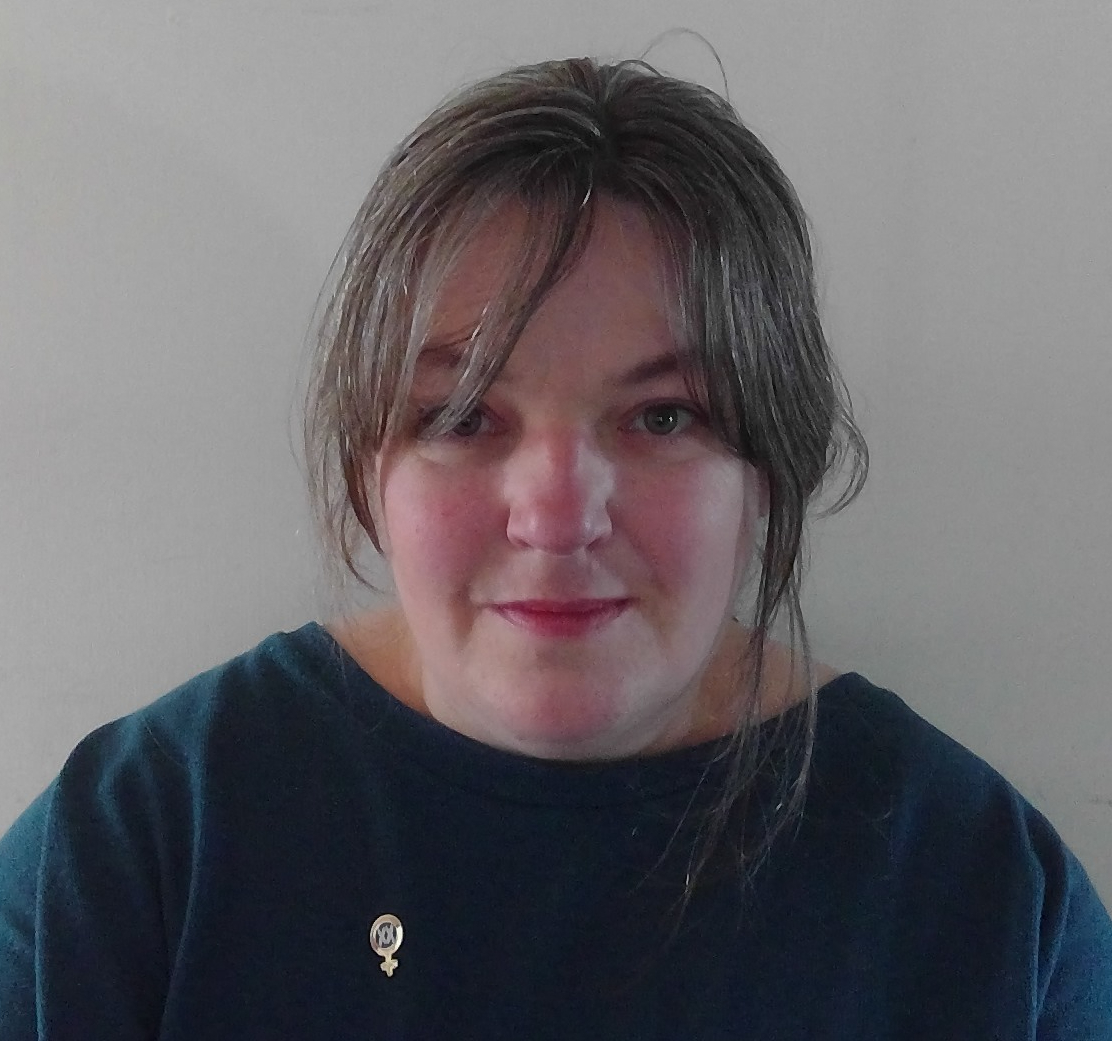

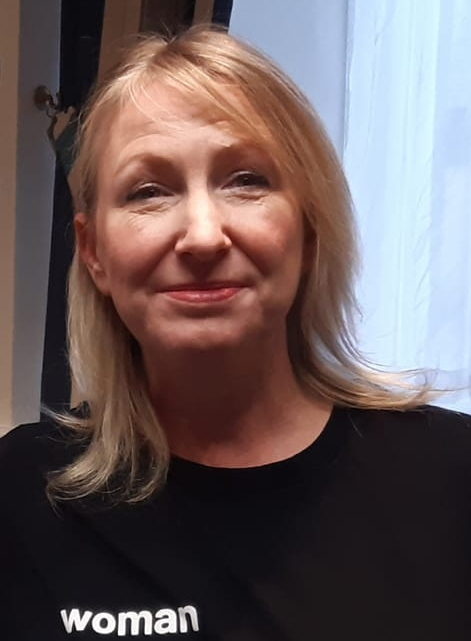
“For Women Scotland, three women who sacrificed much to fight for women’s rights all the way to the Supreme Court, and won. Damn right they are feminist heroes.”
– Susan Dalgety
Aims
Women’s and children’s rights should be protected and strengthened. There are only two sexes, a person’s sex is not a choice, nor can it be changed. Women are entitled to privacy, dignity, safety and fairness.
Our aims are to:
- Campaign on equality and human rights issues impacting on women and children in Scotland.
- Work closely with central, devolved and local governments across the UK and with each of the main political parties in the UK to promote the interests and rights of women in Scotland.
- Participate in cultural and education activities and seek to raise awareness of cultural, health, social and socio-economic issues specifically associated with ordinary women in Scotland.
- Seek, among other things, to promote the welfare of ordinary women in Scotland in terms of their visibility and recognition and access to health and social services, as well as greater participation in civil society in Scotland.
We campaign on a positive, pro-women basis and call for evidence based discussion and legislation.
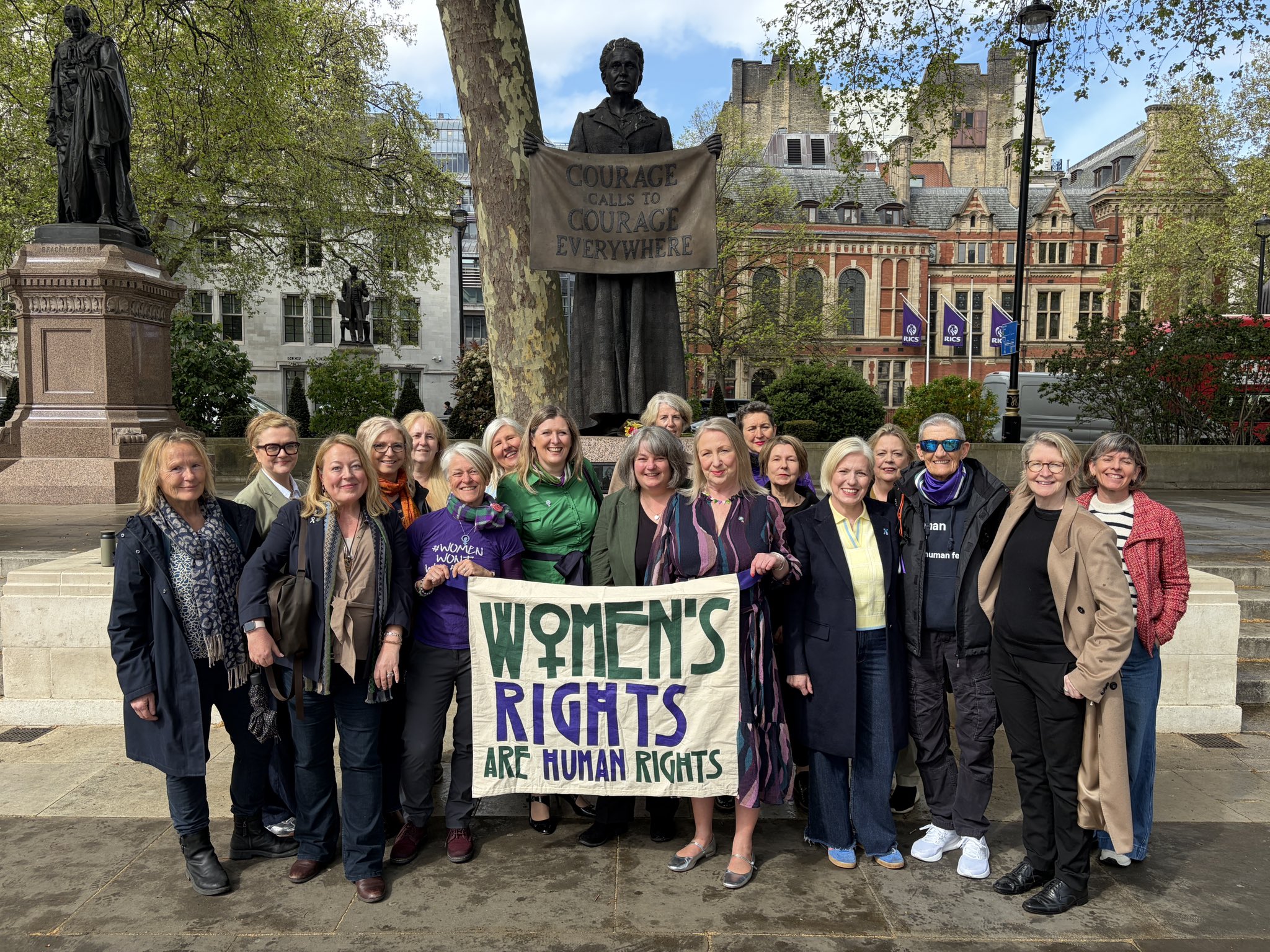
“Marion Calder, Trina Budge and Susan Smith — took on the media, the medical profession, and the political establishment and helped to spark a debate about women’s sex-based rights that has gone global.”
– Iain McWhirter
“An era of magical thinking comes to an end and vindication is a dish to be enjoyed at any temperature. Three cheers for the ladies of For Women Scotland.”
– Alex Massie
What we do
Judicial reviews:
We have taken – and won – two separate judicial reviews on the definition of “woman” in the Gender Representation on Public Boards (Scotland) Act 2018 (GRPBA) and the accompanying Statutory Guidance.
In February 2022 we won the appeal of our first judicial review. The Court of Session ruled that the Scottish Government exceeded its powers by including transwomen in the definition of “woman” in the GRPBA. The judges restated that the protected characteristic of sex refers to either a male or a female and that provisions in favour of women must, by definition, exclude those who are biologically male. Despite this, many organisations continued to operate on policies which allowed people to self-identify as the opposite sex.
In response to this ruling, the Scottish Government issued statutory guidance for the GRPBA which said the protected category of “woman” included those men who had obtained a Gender Recognition Certificate. In consequence we returned to the courts.
In April 2025, the UK Supreme Court unanimously allowed our appeal and established that a certificate does not change a person’s sex under equality legislation.
Despite this unequivocal ruling, the Scottish Government refused to withdraw its prison policy which allowed some male prisoners to be housed in the female estate. A third judicial review followed which we won in June 2026.
Other court cases:
We worked with Leigh Hurley and Sean Stratford to challenge the decision to install mixed sex toilets in their child’s primary school, funding initial legal advice from senior counsel. In April 2025, they won a judicial review ruling and the council conceded that they had a legal obligation to provide separate male and female facilities.
We have also provided support in Sandie Peggie’s tribunal against NHS Fife and were one of the organisations that intervened to ensure the case was conducted in public.
Consultations:
We have submitted responses to Scottish and UK Government consultations and to the United Nations, as well as Scottish sports bodies. Over 60 of these are published on our website and include the Census Amendment Bill, the Hate Crime Bill, and the Gender Recognition Reform Bill. We believe the quality and quantity of our output compares very favourably to the funded women’s organisations in Scotland despite the vast disparity in funding and staffing.
In evidence to the committee on the Hate Crime Bill, we argued that “sex” should be protected in line with the recommendations of Lord Bracadale. Parliament rejected this in favour of a possible future standalone Misogyny Bill. After expending much time and energy on a working group and a report by Helena Kennedy, the Government shelved that idea and followed our suggestion, from six years before, to include sex in the Hate Crime Act.
Our comprehensive report to the UN on The Status of Women in Scotland covered legislation (including Gender Representation on Public Boards and Hate Crime), political representation, data collection, prisons, and single-sex exceptions and the genuine occupational requirement. As a result, we have forged links with women’s organisations working at UN level and with the UN Special Rapporteur on Violence Against Women and Girls, Reem Alsalem.
Public meetings and conferences:
We raise public awareness through well-attended public meetings and demonstrations, and by contributing speakers to panel discussions and other events throughout Scotland and elsewhere in the UK.
We regularly speak with MSPs and all-party groups to promote women’s rights and campaign for consultation and amendments to Bills progressing through the Scottish Parliament.
We are members of the Cross Party Working Group on Commercial Sexual Exploitation.
We are regularly invited to participate as panel members at large conferences like FiLiA and Battle of Ideas.
We have spoken on fringe meeting panels at the Scottish Labour and Scottish Conservative Party Conferences. Last year, we were on panels at both Labour and Conservative national conferences.
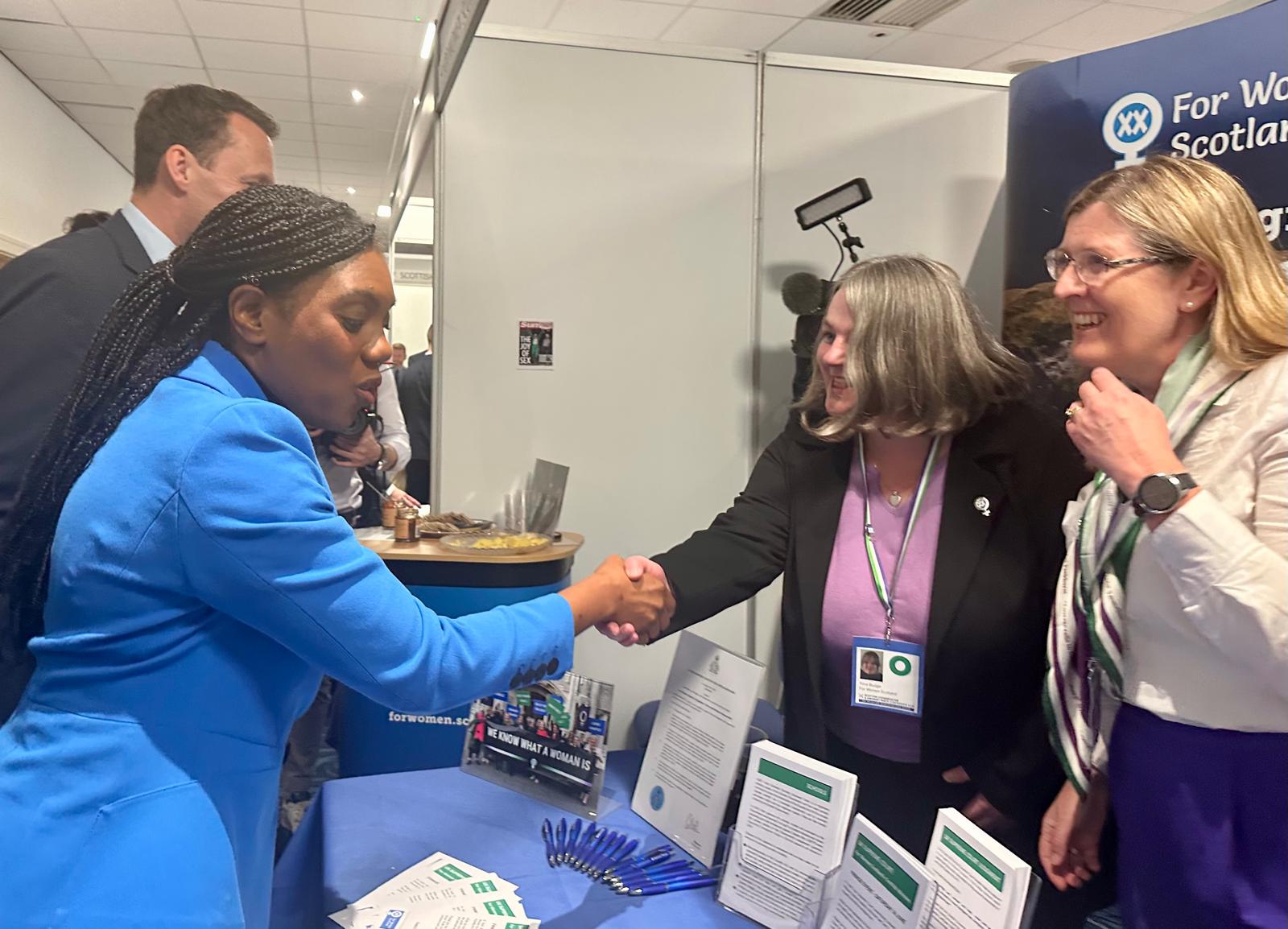
Trina and Susan meeting Kemi Badenoch MP, Leader of the Opposition.
Scottish Conservative Conference, June 2025
Susan speaking at a cross-party meeting.
House of Lords, April 2025

Campaigns:
We held a series of meetings – including in the Scottish Parliament – to raise awareness of the flaws of the Gender Recognition Reform (GRR) Bill. Our campaigns included Bin the Bill, SOS (Save Our Sports, Save Our Schools etc), and If You Won’t Respect My Sex, Don’t Expect my X (during the May 2021 election). The latter campaign slogan was subsequently picked up by groups across the UK.
We identified that the Forensic Medical Services Bill as written only allowed for a victim of rape or sexual assault to request the gender – not the sex – of a medical examiner. This ultimately resulted in the successful #SixWords campaign to amend the Bill: “for the word ‘gender’ substitute ‘sex'”, spearheaded by Johann Lamont MSP.
Our Newsletter reaches over 4,000 people across Scotland (plus over 800 subscribers from outwith Scotland), and we regularly send templates or suggestions for people to contact MSPs or news of petitions and public meetings.
We support the work of local groups across Scotland, providing equipment and leaflets for meetings or street stalls or arranging speakers for local events.
Pulications:
We have produced multiple pieces of work over the past seven years. Recent output includes major reports on Scottish schools and a report on the Convention on the Elimination of all Discrimination Against Women (CEDAW).
In May 2024, we published our report What’s Happening in Your Child’s Classroom? on Scottish schools which has been widely reported in the national press. We set out to mirror the Freedom of Information requests conducted by Policy Exchange on schools in England, and our findings demonstrate that gender ideology is much more embedded in secondary schools in Scotland than in England. This report also highlights how gender ideology beliefs came to be so embedded within the school system, by tracking the influence of the Scottish Government transgender guidance and how external agencies such as LGBT Youth Scotland have gained unprecedented access to schools in recent years.
This report was followed by What’s Happening to Your Child’s School Toilets? based on an additional Freedom of Information exercise to establish the physical layout of school toilets and assess the numbers of secondary schools introducing, contrary to School Premises Regulations, mixed sex provision.
We commissioned a legal opinion from Aidan O’Neill, KC on the legal obligations of local authorities to provide single-sex toilets in schools which we sent to every local authority in Scotland.
In February 2024, we submitted a report The meaning of sex and self-identification to the CEDAW Committee who are considering the implications of self-identification of sex and gender identity as a legal right. It looked at where we were in Scotland after having won one, and lost one, judicial review in the appeal court and how this fits with international law and the Scottish Government’s continuing policy of self-identification. We have also written a report on CEDAW: A case study in the Scottish courts, considering how the Scottish Government performed in its commitment to the incorporation of the United Nations CEDAW treaty by examining our first judicial review where we cited a breach of CEDAW.
We have conducted extensive work on pathways in the Gender Identity Clinics in Scotland. Through Freedom of Information requests, we discovered that 51 Scottish girls under 18 had been referred for mastectomies. We also uncovered that Scottish guidance, the so-called SPATH protocol, heavily relied on WPATH 8 (which included a chapter on “eunuch identity”) even after NHS Scotland was forced to distance itself from WPATH.
Following the scandal at Edinburgh Rape Crisis Centre, we have produced reports on Rape Crisis Centres – by women and for women, in which we assess how services are currently provided for women. We also took an indepth look at the the history of Rape Crisis and the tactics used to shift them from women-only services. The Freedom of Information requests we submitted were key items in evidence for Roz Adams’ successful employment tribunal.
We have produced numerous Factsheets and Leaflets which are available for download and cover key policies and campaigns.
Media impact
For Women Scotland is regularly quoted in the local and national press. Our Directors have appeared on BBC, ITV, STV, Channel 4, Sky GB News, Talk TV, and international news. On radio, we have been interviewed on BBC Radio 4 (including PM, Woman’s Hour, and Antisocial), BBC Radio Scotland, LBC, and local radio.
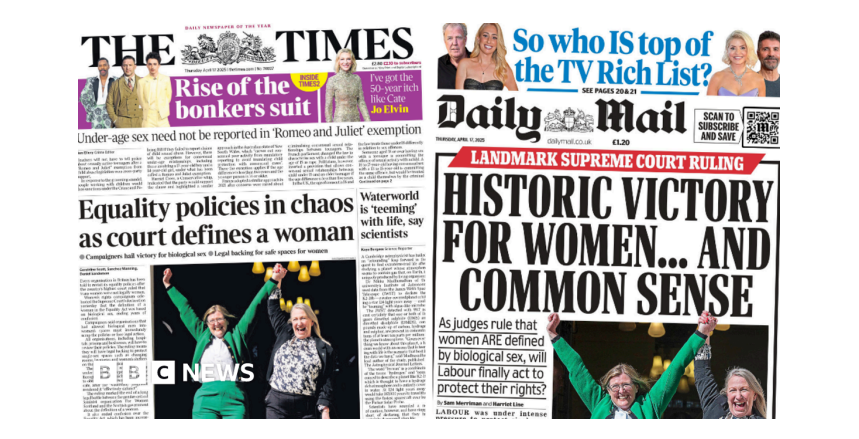
Following the victory in the UK Supreme Court, we made front pages across the world and were interviewed extensively by UK and international outlets.
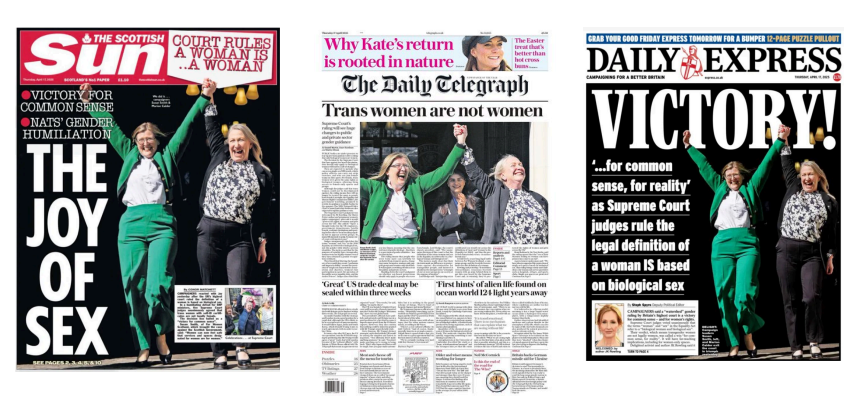
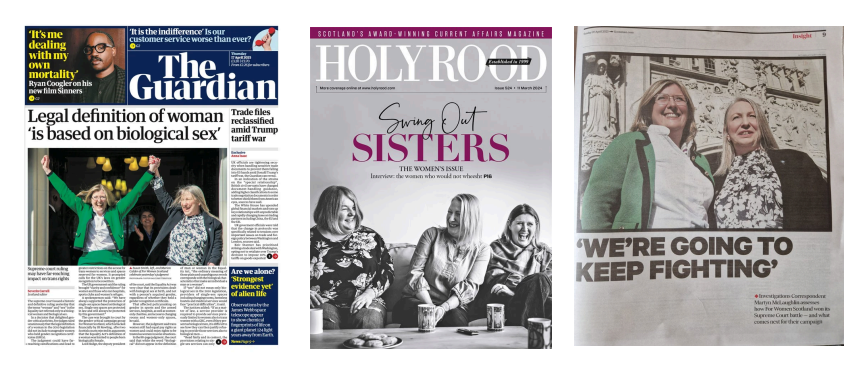
Even before this increased exposure, a (hostile) report from RESIST, a “queer feminist research consortium” claimed that we were one of the “two most cited organisations in the sample” they had taken from Telegraph reports and that we were mentioned as frequently as Mermaids. In terms of coverage of the Scottish GRA reform, they claim we are “quoted 500% more than any other campaigning group in discussion of the legislation”.
Our work has been cited by MSPs and MPs in Holyrood and Westminster.
“The Supreme Court ruling is a powerful victory for the determined women behind For Women Scotland”
– Kemi Badenoch, leader of the Opposition
“I welcome the Supreme Court’s ruling and congratulate For Women Scotland and others who have campaigned tirelessly on this issue despite the abuse, threats and attempts to silence them.”
– Harriet Cross, Conservative MP, Gordon and Buchan
“I welcome the Minister’s statement and put on record my thanks to For Women Scotland for its tireless work over a number of years. It was the public face of many women who have experienced discrimination, abuse and personal loss for making the argument that the Supreme Court made last Wednesday. The Supreme Court held up the rights of lesbians to be able to associate with same-sex attracted women.”
– Tracy Gilbert, Labour MP, Edinburgh North & Leith
“While Scotland suffers this madness, we are also blessed with heroically brave women who are fighting and winning.”
– Johann Lamont, former MSP & leader of Scottish Labour
“Let me first congratulate the tenacious trio who are here today from For Women Scotland. Marion Calder, Susan Smith—I am sorry; I am getting emotional—and Trina Budge courageously fought for women’s sex-based rights from their kitchen tables to the highest court in the land. After meeting on Mumsnet, those three incredible women defended women’s rights while the SNP Government and its army of lawyers did their best to dismantle them.”
– Tess White, Conservative MSP, North East Scotland