Invisible women
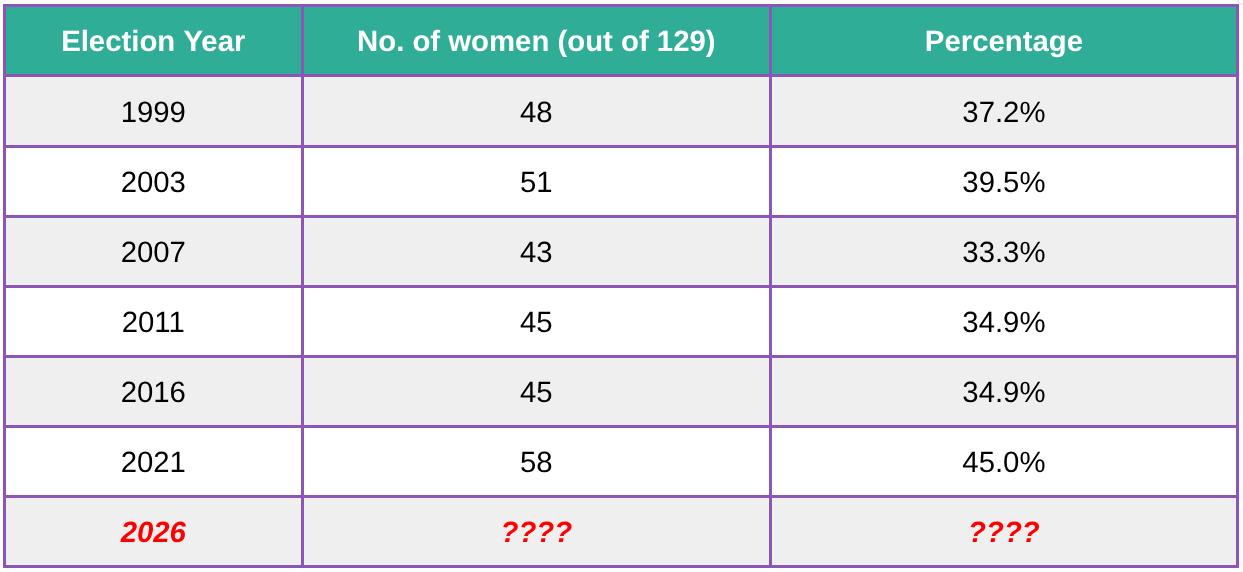
Despite being 51.4% of the population women have consistently been under-represented as Members of the Scottish Parliament (MSPs). In 1999, women made up just 37% of the 129 Parliamentarians but, after a drop in 2007, rose to the highest ever level of 45% in 2021. Women campaigned for equality during all those years (and even longer!) and various initiatives to encourage women to stand as candidates, as well the use of women-only shortlists, have attempted to bridge the gap.
The only way to measure progress is to count the number of women elected. This year, 55 women and 74 men were elected to Holyrood. This is a drop from 45% to 42.6%. While it is disappointing to see fewer women elected, we don’t know if this is a minor blip or the start of a worrying trend that, according to The National, we need to take “decisive action” on.
Either way, we need the data. And we need that data to be accurate. It is concerning then, that the National reports there are 56 female MSPs when there are only 55 – the situation is even worse than they feared! The source of that erroneous data is the Scottish Parliament itself, where for many years a simple search on its website for current MSPs would quickly display the total number of female MSPs along with an alphabetical list by surname. This year however, a search for newly elected female MSPS returned the following result: (This search can still be performed via the archive of the web page.)
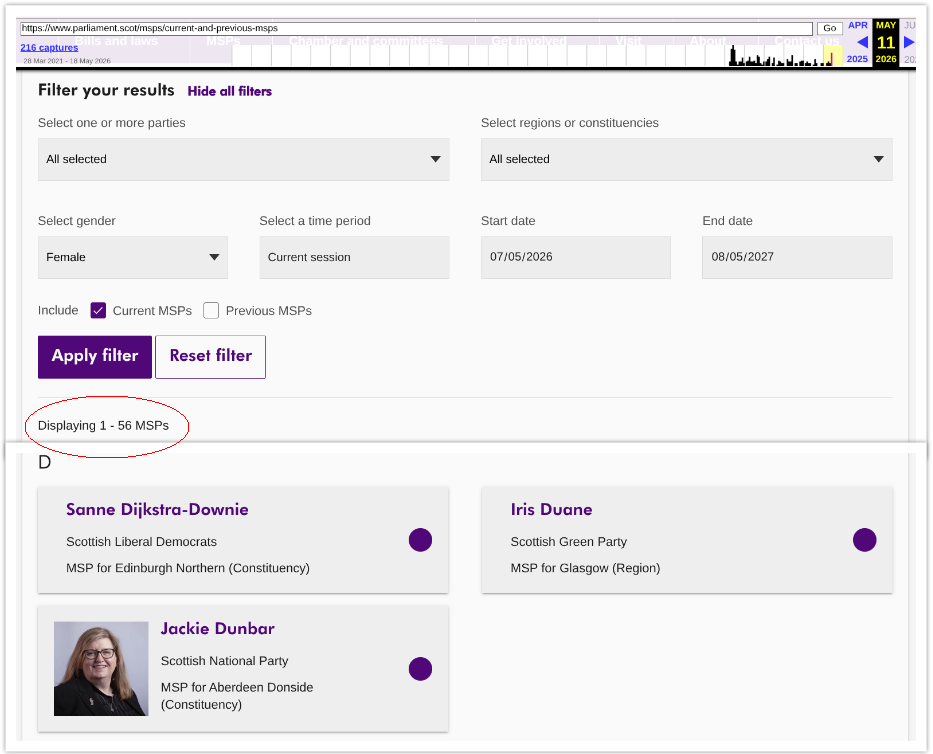
NB. We’re not sure why the label “gender” is used when the Scottish Government has never been able to even define it, and when the listed categories are sexes: male and female.
The extra “woman” is Iris Duane, who is not a woman at all, but a biological man who identifies as a woman. The inclusion of Duane as a woman is contrary to our UK Supreme Court ruling that the terms “woman”, “man” and “sex” take their ordinary, biological meaning in the Equality Act 2010. Collecting and monitoring data on the protected characteristic of “woman” falls squarely under this legislation and, just as it was ruled unlawful for the Scottish Government to include men in women’s representation on public boards, it is equally unlawful for them to do so for women’s political representation.
Another newly elected male MSP declared a “non-binary” identity and so a new category was created especially for him, which further distorted the data. The removal of these two men from the male category means that men now account for 55.8% of Parliamentarians, instead of the accurate figure of 57.4%.
Perhaps due to a number of complaints from unhappy women – or perhaps the lawyers had a word – the MSP search facility was once again updated on the 18th May.
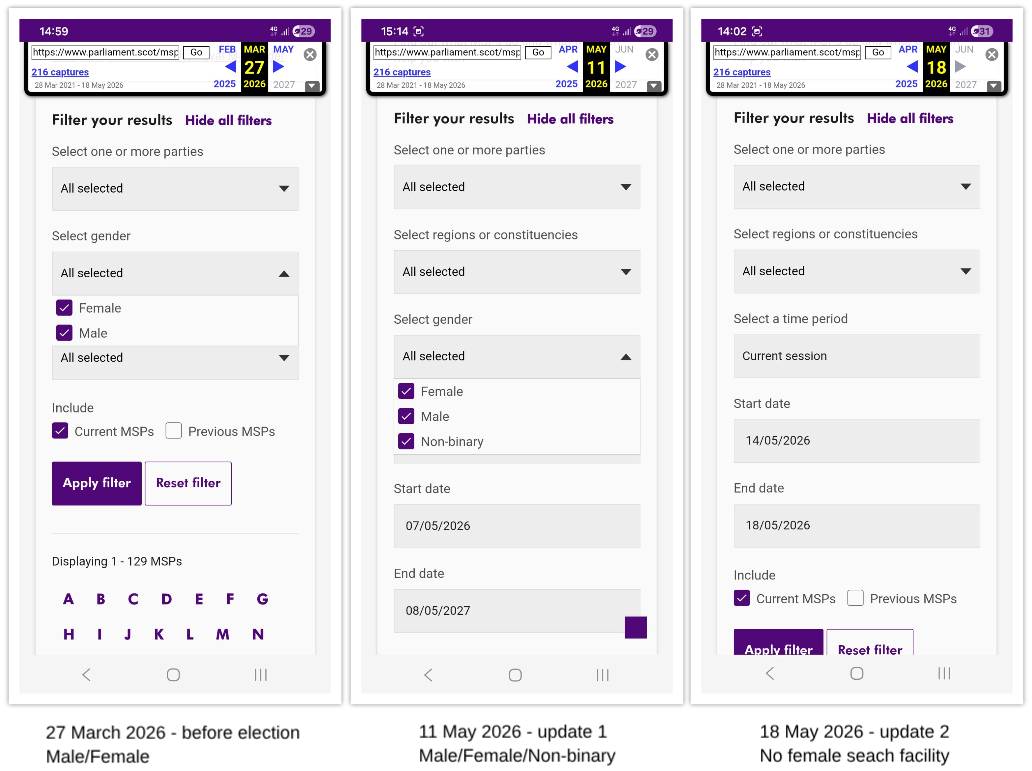
However, rather than correcting the error, women have been quietly removed. The option to search for female MSPs vanished overnight, and along with it, the public record of women’s current and historical representation in Parliament. It would seem that if men cannot have women’s things then women cannot have them at all.
We are calling for women’s representation to be visible again on the Parliament’s website. Women are 51% of the population and our Parliament should reflect that fact. Women count…so count women.
You can find the contact details for your eight MSPs by entering your postcode here. Please email each of them asking that they write to the Equalities Minister to request action is immediately taken to restore women’s data to our Parliament.
You can also submit a complaint directly to the Scottish Parliament on their website here.
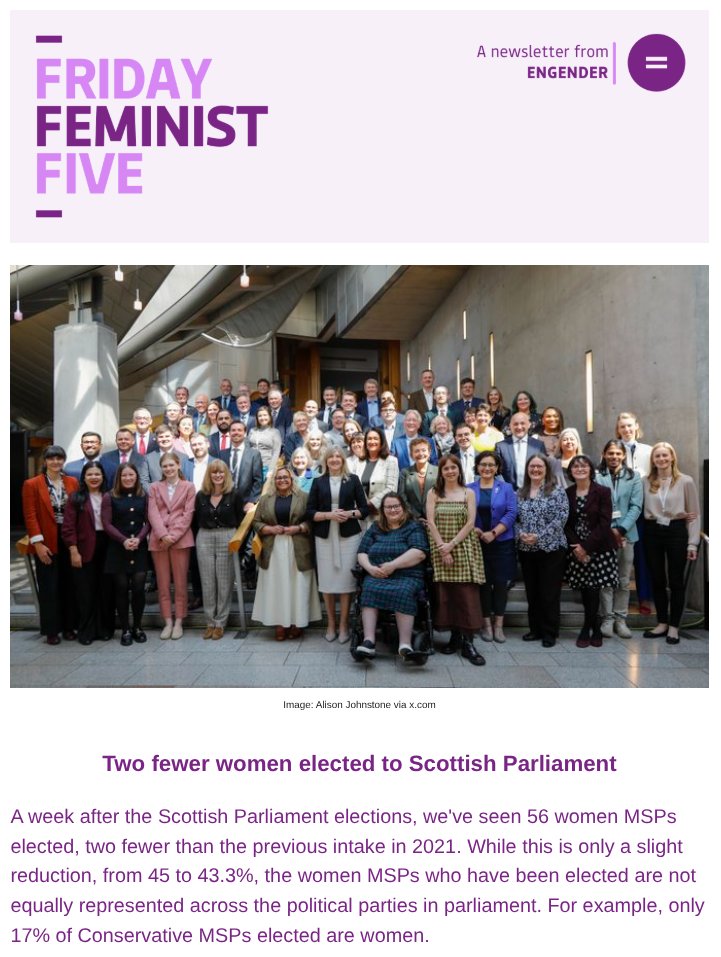
Engender sent out a newsletter last Friday playing the same silly game with women’s equality data, stating (incorrectly) that 56 women were elected instead of 55 women. We have asked them to issue a correction – if you would like to do the same, they can be contacted at info@engender.co.uk.