
Pop goes Parliament
John Swinney’s announcement that he would not meet with Reform has opened the First Minister up to accusations of performative politics and hypocrisy. Having said he wanted to represent all Scots, it seems that this only extends to certain Scots. Of course, the nearly 400,000 people who voted for Reform isn’t the only group the First Minister has deemed pariahs. Despite repeated promises, Swinney has avoided discussions with women’s rights activists about his Government’s inability to implement law.
Politics, naturally, involves game-playing, but, in recent years, we have seen the rise of a peculiarly anti-intellectual form of politics: one that doesn’t involve debate, discussion, reason, and enquiry, but begins with fixed assumptions and works backwards to demonise anyone who disagrees. Again and again, this approach backfires, and yet politicians seem unable to resist the lure of a reductive system built on mantras and thought-terminating cliches. And it’s a disease which affects all parts of the body politic, especially in Scotland.
If you have kicked around Social Media for long enough, you will have seen cartoons like this one taking a very elastic view of the so-called Popper Paradox ot Tolerance, an idea, incidentally, not in the main body of Karl Popper’s work, but in a footnote.
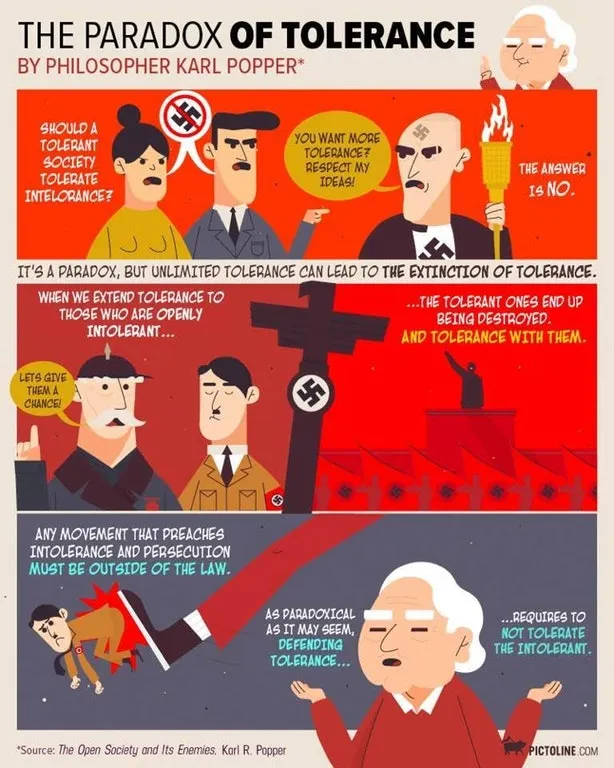
Boiled down to its most basic (and boy do the cartoonists boil it down), Popper says that one should be intolerant of intolerance. Or, to put it another way, that some ideas are not worthy of respect in a democratic society. But which views and who makes the determination? Popper, like Mr Justice Choudhury in the Forstater case, actually sets a pretty high bar, saying:
“I do not imply, for instance, that we should always suppress the utterance of intolerant philosophies; as long as we can counter them by rational argument and keep them in check by public opinion, suppression would certainly be unwise.”
His graduated response involved first countering intolerant philosophies with rational arguments and only taking more repressive measures when proponents of these ideas “forbid their followers to listen to rational argument, because it is deceptive, and teach them to answer arguments by the use of their fists or pistols.” This is in line with the Forstater ruling which set out that only beliefs which would contravene the European Convention on Human Rights and “espouse hatred, violence or a totalitarian ideology that is wholly incompatible with the principles of democracy” cross a line. It hardly needs saying that women’s rights activists opposed to gender recognition reform were not resorting to fists or pistols.
There is a risk that, by skipping over stage one of Popper and heading straight for the end stage, politicians risk inflaming, rather than calming conflict. If you say that some people are so morally corrupted and wicked that you will not let them in the room for a conversation, you are likely to stir up animosity on all sides, and if you cannot articulate your opposition to their views, inevitable questions will be asked about the quality of your own ideology and if you are simply trying to evade interrogation.
The outstanding example of this in recent years is the “No Debate” mantra on trans demands. Branding opponents of Gender Recognition Reform worked well for a time, it intimidated women and created hostile environments but once a few voices were able to break through, it became clear that this was a philosophy built on sand. When these walls crumbled, it was evident that this version of Popper was a complete inversion – an intolerance of perfectly reasonable, lawful views which is much more closely aligned to a totalitarian mindset.
The SNP’s version of “civic nationalism” is supposed to encourage such lofty aspirations as freedom, tolerance, and equality. Many of us want a Scotland which encourages engagement and openness. Yet, if you narrow the field of views that will be permitted and frighten people out of engaging in an exchange of ideas, freedom and tolerance are no longer on offer.
The SNP are only surpassed by the Scottish Greens in adopting faux Popper theories and dealing with inconvenient opinions by quashing them and pretending that they are inspired by “bigotry”. The Greens claimed in the manifesto that they want to “build diverse, strong and united communities”. This has appeal: who wouldn’t want harmonious neighbourhoods free of tensions and discrimination?
But their approach is naive to the point of idiocy: a diverse community is always unlikely to be “united” in the way the SGP envisages. It will, by definition, encompass a plurality of views and political opinions. It should be possible to rally round the notion of hearing others with tolerance and forbearing but it precludes unanimity of thought – and that is how it should be.
Frequently, opponents will say that groups like FWS “don’t speak for all women” as though we thought we did or ever could. But the notion that there is an approved form of group-think which all members of one characteristic should embrace wholesale is another facet of the modern culture wars. The devastating impact of this imposition of uniformity on campuses was laid bare in the recent two part Storyville documentary, Speechless, The New Campus Revolution. This included the hounding of Erec Smith, a Black professor of rhetoric, who faced bizarre accusations of racism for upholding the principles of Classic Liberalism and rejecting Critical Social Justice.
This is not an isolated case, it’s an all too frequent (and despicable) weapon wielded against those who are thought to betray their tribe. Earlier this month, a white activist took to X to accuse former chair of the Equality and Human Rights Commission, Trevor Phillips, of having the wrong opinions for a Black man. When Black lesbian KC, Akua Reindorf, joined in, he doubled down and accused her of betraying her race by joining the “establishment” – by which he meant achieving success in the legal world.
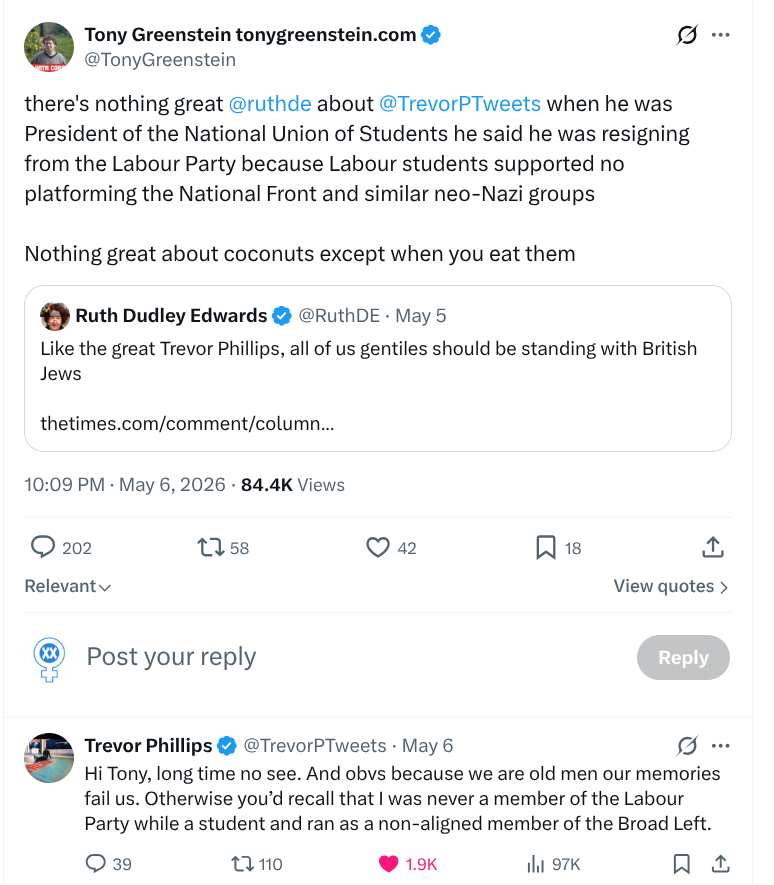
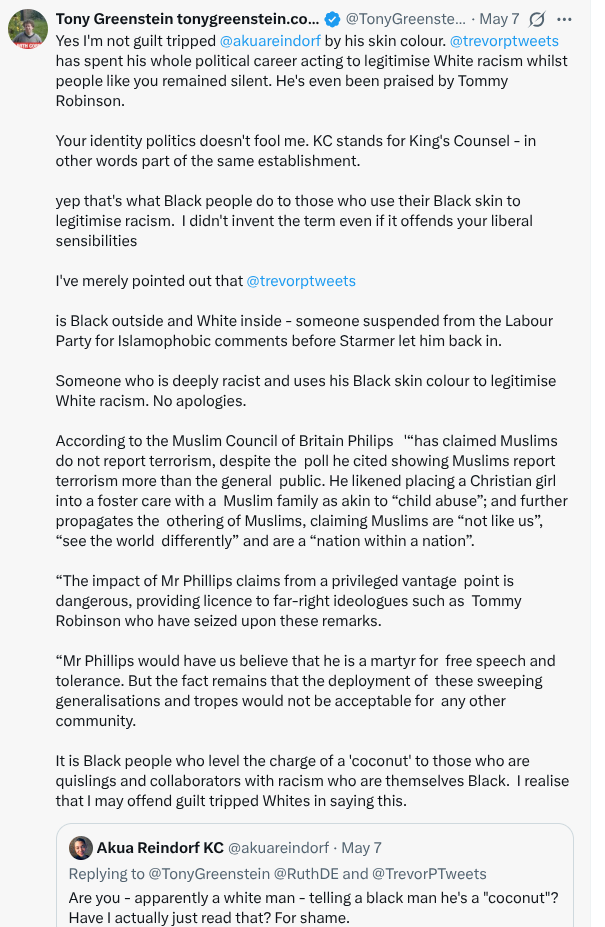
It’s not hard to see this as an outlet for racism – albeit of an “approved” kind. Because Phillips and Reindorf, like Smith, have the “wrong” opinions they can be targeted with demeaning language and assumptions.
This particular brand of racism dressed up as progress is also often directed at politicians, especially Conservatives. One of the most shocking moments during the committee scrutiny of the Gender Recognition Bill in 2022 was when Pam Gosal – the first woman from an Indian background elected to Holyrood – spoke about the impact of mixed sex spaces on minority religious groups. Activists who like to boast about how diverse and inclusive they are, took to social media to say that religion didn’t excuse “bigotry”. It’s possible that this sort of response, and the resistance within civic Scotland to any suggestion that some single-sex provisions might be necessary for minority women, prompted the decision of one organisation to give evidence off camera.
In the same way, gay men and lesbian women who have spoken out against the direction of travel of Stonewall and other groups over recent years have been accused of being “quislings”, “straight acting” or “self-hating”. This is ironic in a movement which, all too often, turns gay and lesbian youth into poor facsimiles of the opposite sex so they can pretend to be straight. It’s also frequently used to justify the most revolting homophobia under the guise of protecting “queer” or trans rights.
Some of the worst offenders in the modern day thought police are Scottish Green or SNP activists and the leaders have been known to join in. Patrick Harvie, then leader of the SGP, even accused Nicola Sturgeon, enthusiastic cheerleader for self-id, of allowing transphobia to “fester” in the party, comments which were felt to be directed at former MP, Joanna Cherry. Diverse communities, it seems, cannot include anyone who professes views which the Scottish Greens or other champions of social justice dub intolerant, even if they are part of the minority groups these warriors affect to champion.
So who decides what opinions are “bigotry” and which are acceptable? The most common position from proponents of trans ideology is that trans people set out the terms. This has always been a very one-sided equation, however, as the same privilege is not extended to women or LGB people who see much misogyny and homophobia in trans activist language. The Liberal Democrats found out the hard way that adopting the sort of hardline definition of transphobia demanded by activists was not in line with the law and dropped references to “deadnaming” and “misgendering”.
The Scottish Green Party , however, continues to say that “the intentional misgendering of transgender people is a highly distressing form of harassment and abuse that constitutes transphobia.” Their hardline approach on transphobia has led them to expel members, sever ties with Green Party of England and Wales for not being hard line enough, and revile some of their better known and respected former MSPs.
Harvie’s co-leader, Lorna Slater was also uncompromising in her language and argued that media outlets like the BBC should ban women’s rights activists: “We wouldn’t put balance on the question of racism or anti-Semitism, but we allow this fictional notion of balance when it comes to anti-trans [views]. The whole thing is disgusting.”
There’s a massive elephant in the room which Slater inadvertently drew attention to. Just as there is debate about the definition of transphobia, so there is resistance to some definitions of antisemitism and, it just so happened, that this led to questions about the Bute House agreement and the Greens inclusion in Government.
The Scottish Government’s position is that it accepts the IHRA definition of antisemitism. The Greens, however, reject this and have explicitly fallen foul of it by passing motions describing Israel as a racist state.
It seems that there are a range of responses to the SGP stance, including (but not limited to):
- They are correct in their assessment and have every right to reject the definition and make their case.
- They are incorrect and, by rejecting the definition, prove that they are intolerant bigots who forfeit the right to enter into debate on the subject.
- They are incorrect, but that does not mean that they should be silenced and should, instead, be met with counter arguments.
The SGP and supporters would, naturally, go for option one but there are many others who would take the opposite position. The question then is does a liberal society which tolerates a plurality of views allow the Scottish Greens to hold this position or is it too extreme and crosses the “worthy of respect” line?
Adjudicating on the rights and wrongs of this is not the purpose of this essay, however, it is a useful illustration that the Greens are prepared to take issue with definitions of prejudice if they deem them inappropriate or a barrier to political discussion. It would, however, be easier to have sympathy with this position if they did not also adopt wholly arbitrary and very Draconian definitions of “bigotry” with regard to other groups, attempt to impose them on society at large, and demonise anyone who rejects them. At best, the SGP is monstrously hypocritical.
The Greens also fail to understand that bossiness, high-handed sneering and name-calling is not the way to win hearts and minds. Arguments must be won and won fairly. Beyond the cosy vegan cafes of Edinburgh, community building needs more than finger wagging and, crucially, it must include all those people who voted for people the Greens and the SNP disapprove of (and not in a way that involves Clockwork Orange style re-education).
If the SNP and the Greens are serious about diverse communities, they must embrace them in all their messiness. Accusing opponents of racism, bigotry, or homophobia was effective for a time, but eventually it loses its sting, especially when those accused of these crimes are, themselves, from these minority groups. When everyone is a bigot, how can we really determine who the truly dangerous are? If ideas are bad, the best way to expose them is to let proponents speak. Again, there is a reason trans identity ideology was forged in the shadows. Of course, this requires that politicians have the intelligence and eloquence to make rebuttals, and perhaps this is where the problems lie.
Talking with people we dislike or distrust can be difficult. It can also be painful when there are deep wounds and a failure of justice. Yet, but for talking, there would have been no Good Friday Agreement in Northern Ireland and no end to Apartheid in South Africa. If Nelson Mandela can shake the hand of FW de Klerk, why can John Swinney not meet with women who think sex is real?
Over 150 years ago, John Stuart Mill set out the danger of a blinkered approach: those who try to suppress speech are not infallible and power should only be exercised to prevent harm, not to forbid ideas which are better countered by “remonstrating” or “reasoning”. Squashing heresies doesn’t make them vanish, it simply makes people afraid and limits their intellectual capacity.
It seems so simple and so reasonable. Yet, for the SNP, the SGP and, sadly, the party which should uphold the ideals of Mill, the Liberal Democrats, the lure of absolutism is strong. The list of ideas or questions not to be “tolerated” grows and dissension is met with ad hominem attacks. The word “Parliament” derives from the French for “to talk”. To be an effective Parliament, Holyrood must have MSPs who are not just adept at reading from a prepared script, they must be able to enter into dialogue, to set out a case, to dispute points. And they must also learn how to listen. Parliament cannot be an echo chamber, it cannot make members of the public afraid to ask questions, it cannot only pay heed to those who flatter and confirm the Government’s world view. It’s time the Government did its job. It’s time to talk.