
Scottish Election 2026 Guide
Voters will go to the polls on 7th May 2026 to elect Members of the Scottish Parliament (MSPs).
A total of 129 MSPs are elected and they debate and pass laws on devolved issues, which include health, education, transport, as well as some of the laws regarding tax and welfare. The UK Parliament at Westminster retains control over reserved issues such as defence, foreign policy, immigration, and equality legislation.
How does voting work?
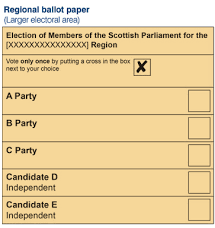
Everyone who is eligible to vote in Scotland has two votes – one for a Constituency MSP, and one for the Regional ballot.
There are 73 constituencies and an MSP for each is elected on a first-past-the-post system – the winner is simply the candidate who receives the most votes in each constituency.
There are 8 regions and 7 MSPs for each are elected on a proportional system. People vote for a party who are then allocated a number of MSPs once a formula has been applied to the results. This is sometimes known as the “list vote” as each party will publish a list of their preferred candidates.
This means that everyone in Scotland is represented by eight MSPs – one representing their constituency and the other seven representing their region.

Who can I vote for?
Enter your postcode at Who Can I Vote For to find out who your constituency candidates are, and their contact details. The details of the parties standing in each region and their ranked list of candidates is also given.
Who should I vote for?
Obviously people will have all sorts of priorities when deciding who to vote for but we would encourage everyone to contact their candidates and ask where they stand on women’s rights. We think it is vitally important that anyone we vote for respects the decision of the UK Supreme Court, and will commit to upholding the single-sex provisions in the Equality Act.
Women’s Rights – what’s happened and what do the parties propose?
The outgoing SNP Government gained an exceptionally poor record on women’s rights over the last five years, most notably in spending virtually all that period in court arguing that “woman” is not a biological sex class and that men can access our rights at will. Having lost the case in 2022 that a man could take a woman’s place on a public board if he declared himself to be a woman, the SNP proceeded with highly contested reform of the Gender Recognition Act on the basis that any man would be entitled to enter women’s spaces and services if he first obtained a certificate from the state for his self-declaration as a woman. This Bill was passed by Parliament with the support of Scottish Labour, Greens and the Lib Dems. The Scottish Conservatives fought tooth and nail against the Bill and it was, thankfully, later blocked from becoming law in 2023 by the then Conservative UK Government.
The SNP maintained their belief that a gender recognition certificate (based on a medical diagnosis) turned a man into a woman for the purposes of the Equality Act and court cases continued until 2025 when the UK Supreme Court ruled to the contrary and that “woman” did indeed take its normal, ordinary biological meaning and GRCs did not change this.
The SNP says it accepts the Supreme Court judgment but to date the only implementation has been forced by further legal action on guidance for schools and the Government’s own staff policy. Their Working Group on applying the court decision has had no visible output since it was set up a year ago and government guidance on data collection still advises against collecting information on women. Worryingly, the new tactic is to argue that while men are indeed biologically male their “human rights” usurp the Supreme Court ruling and they can still access women’s spaces. We are currently awaiting a court decision on the SNP Government’s defence of their policy on continuing to house male murderers in the women’s prison estate.
To date, the SNP has squandered over £1.3 million of precious taxpayers’ money on these cases.
Scottish Labour have recognised their previous failures in this area and across all manifestos we would like to see, not just acceptance of the Supreme Court decision, but genuine support and implementation of it for the benefit of women. Women’s health inequalities cannot be effectively addressed without recognising sex differences and founded on sex specific research, nor can male violence against women be tackled without a solid understanding of sex differentiated crime statistics and provision of single-sex trauma services.
Almost five years after the Hate Crime and Public Order Act 2021 was passed the SNP Government finally conceded and added biological sex as a characteristic deserving protection, but proposals for misogyny legislation remain a concern for providing another vehicle to shoehorn self-id of sex into law. Banning of conversion practices for “gender identity” is another prospect to be wary of as the Bill, as currently drafted, would criminalise parents, teachers and therapists for questioning children or helping them to feel comfortable with their body.
So, with all that in mind, let’s see what each party’s manifesto has in store for us. We will concentrate on the six that are most likely to make up the next Parliament.

The SNP manifesto includes:
- Review of maternity services and IVF (widening access to single women and same sex couples)..
- Research into menstrual health
- Reduce gynaecology waiting lists.
- “Christina Card” to every woman at age 50 with advice on menopause support and screening tests.
- Include pregnancy as an aggravator in domestic abuse cases.
- Ban deepfake intimate images.
- Establish a specialist sexual offences court, provide the right to lifelong anonymity for sex offence victims.
- Remove the “crime of passion” defence from homicide law.
- Grants of up to £50k to minority-ethnic women who have started businesses.
This seems a little niche and we’d be interested in seeing the evidence justifying such a specific positive action measure. - Introduce a Misogyny Bill.
- Criminalise the purchase of sex (after consideration by an independent Commission).
All of these depend on knowing what a woman is and we can safely predict a lot of unnecessary time and effort will be required to try and prevent the SNP addressing women as “cervix havers” or “pregnant people”. Unless the current data collection guidance is withdrawn further legal action may be necessary before the NHS and other organisations collect accurate data on women. The misogyny bill mostly duplicates existing offences and plans to incorporate self-id of sex, so is highly likely to result in harassment charges against women for referring to a man as a man. Also, having long considered the purchase of sex as a form of violence against women, it is inexplicable why the SNP failed to progress any legislation and refused to support Ash Regan’s bill in the previous session.
There is not one single reference to the Equality Act or the Supreme Court judgment in the manifesto and no commitment to rectifying the many years of policy based on misrepresentation of the law: no plans to restore single-sex facilities in schools, women’s sports, hospital wards or tackle the third sector organisations who continue to be Government funded yet are not compliant with the law. We are relieved that no manifesto commitment has been promised on the School Premises Regulations, as recently consulted on, so hopefully the plan to introduce mixed-sex toilets and changing rooms for pupils will not transpire.
Significant points of concern in the manifesto include:
- Introduction of a Bill to ban conversion practices if the UK fail to bring forward legislation.
The SNP state they have a Bill ready to be introduced in the first year of the new Parliament. This has previously been consulted on, predates any evidence from the Cass review and is extremely problematic on the concept of “gender identity” as it would criminalise parents and therapists who would wish to take a more exploratory approach to help children resolve confusion over identity and body acceptance. - Continue to include LGBTQI+ education in the school curriculum.
Our 2024 research shows that 89% of secondary schools teach that people have a “gender identity”, which is nothing more than a contested and un-falsifiable belief. Misinformation on the law is widespread and the majority of schools affirm children’s new trans identities and enforce preferred pronoun use. We see this as hugely problematic, locking children into transition pathways and it is essential that this policy is replaced with neutral, evidence-based teaching. - Uphold and protect the human rights of trans people as far as possible within our powers, and introduce a Human Rights Bill.
This proposal is fraught with constitutional issues and so far the SNP are unable to even determine which aspects are devolved and which are reserved. A previous attempt to introduce it was dropped and, given the current (erroneous) SNP claim that human rights allow access to opposite sex provision, this is potentially another legal battleground.
Sky News, 18 January 2026
One of the worst responses we’ve seen to the question: “You’re asking for people to vote for biological males to be put in women’s prisons?” Yes, agrees Stephen Flynn, but they’re voting for much more than just that…don’t forget the free bus travel.
Sky News, 03 May 2026

The Scottish Conservatives manifesto reflects that it is one of the few political parties that has genuinely taken women’s concerns for safety, privacy and dignity seriously and will tackle the various harms associated with pernicious gender ideology. A joy to read after ploughing through the SNP’s offering and with no mention of conversion practices, they are highly likely to challenge any such proposed Bill in the next Parliamentary session.
Women’s Health:
- Ensure women have the right to be seen by a female GP and every practice has access to a women’s health specialist.
- Single-sex wards in line with the Supreme Court’s ruling on biological sex.
- Prevent any downgrading of maternity and neonatal intensive care units.
- Urgently start a review of maternity services.
- Expand provision of fertility and IVF services.
- Improve access to menopause and endometriosis services.
- Deliver a Women’s Health Charter to guarantee access to healthcare and improve treatments for female specific issues.
Sex:
- Ensure the Supreme Court’s ruling that sex means biological sex is respected. That starts by ensuring women and girls have access to single-sex spaces throughout the public sector, including hospitals, schools and prisons. In particular, biological men must be removed from women’s prisons.
- Scrap the Scottish Government guidance that encourages the teaching of gender ideology in schools.
- Taxpayer funded organisations must declare any lobbying activities they carry out in a public register, even if these are directed towards public bodies rather than government ministers – this transparency would help prevent situations such as Scottish Trans influence over the prison policy.
- Stop unnecessary guidance such as the Non-Binary Equality Action Plan and guidance on collecting data which suggests there are at least 24 genders.
Justice:
- Full and independent enquiry into grooming gangs.
- Raise the minimum age of marriage to 18, ban first-cousin marriage.
- Outlaw public bodies from discriminating against charities and businesses for their political views when it comes to funding decisions.
- Restore the “priority needs” test to give homeless pregnant women priority for settled accommodation.
- Perpetrators of violence against women and girls punished more harshly, abolish early-release schemes for prisoners.
- Introduce legislation for a register of domestic abuse perpetrators.
- Introduce Claire’s law to restrict repeat abusers being granted bail and improve information sharing across agencies.
- Consult on a new law to tackle non-fatal strangulation.

The Scottish Labour manifesto shows that they have also listened to women. It has a wide-ranging and comprehensive set of pledges upholding the Equality Act and measures to tackle violence against women and children, including on grooming gangs. They also have a section on women’s health which, again, pledges to uphold single-sex wards as well as improving areas such as maternity care and menopause. The policies on improving access to childcare and support for working families are better thought out than the SNP plan to deliver “free” school bags.
We are also interested to note that Labour are pledging to reduce the number of quangos “by at least a third to improve value for public money and cut waste and duplication”.
There is one mention of conversion practices: they will “work to deliver a conversion practices ban on a four nation basis to prevent the creation of any possible loopholes across the UK and protect LGBT+ people from harmful conversion practices.” Tellingly, there is no commitment to a unilateral Scottish approach and no mention that it would cover gender identity, but is one to keep an eye on.
Single-sex spaces:
- Keeping women’s prisons for women, instructing the Scottish Prison Service to remove all biologically male prisoners from women’s prisons within days of the election.
- Recommit the NHS to delivering single-sex wards on the basis of biological sex, and ensuring patients can request same sex provision wherever possible.
Violence Against Women:
- Establishing a Misogyny Reduction Unit and treating violence against women and girls as an issue of public health with research and evidence-based interventions.
- Closing legal loopholes around sexual deepfakes, ensuring the law criminalises the non-consensual creation of images, as well as the sharing of them.
- Preventing bail for those with histories of violence to women, tightening bail laws so those with a history of domestic abuse and violence cannot be bailed to their current or previous partner’s address.
- Boosting uptake of the Equally Safe Programme in schools, with a graded participation award so that young people and parents can see the work that schools are doing to counter the impact of online misogyny and abusive behaviour.
- Continue funding for Rape Crisis and Women’s Aid, ensuring resources are delivered to local services which support victims around the country.
- Creating a specialist victims’ support team to act as a single point of contact for victims of crime to answer questions in a trauma-informed way.
- Modernising the victims’ notification scheme to create a digital portal where victims can access updates and information about the progress of their case through the justice system and control the notifications they are given.
- Delivering a national Bairns Hoose model, so child victims or witnesses of violence can engage with the justice system and recovery services in child-friendly environments.
- Removing parental rights of child sex offenders.
- Progressing the grooming gangs’ inquiry.
Women’s Health:
- Deliver safe maternity services with a national plan to drive improvements where services have fallen short and ensure that women can access quality maternity care no matter where they live.
- Guarantee support for new families, training and recruiting the health visitors needed to provide home visits between pre-birth and a child turning five.
- Reverse the decision to downgrade Wishaw neonatal unit, pausing the plans to centralise specialist neonatal units across Scotland, and commissioning a new review of services.
- Recommit the NHS to delivering single-sex wards on the basis of biological sex, and ensuring patients can request same sex provision wherever possible.
- Tackle long waits for gynaecological procedures, improving speed of access to colposcopies, laparoscopies and hysterectomies, and diagnosing endometriosis faster.
- Provide menopause clinics in every health board region.
- Protect women’s reproductive rights, ensuring that they are able to access the full range of reproductive services, no matter where they live.
Update 27 April: Scottish Labour has now published its Women’s Manifesto.

The LibDems manifesto seems stuck in 2021 with its pledge to address the shortcomings of the gender recognition process. Alex Cole-Hamilton has said in interviews (see below) that this would not be in the next Parliamentary session as it needs time to “settle” – presumably long enough for women to forget about it before sneaking it in.
There are some positives for women, including a special focus on ending medical misogyny so women’s symptoms aren’t dismissed, and prioritising research and training on conditions including endometriosis and the menopause. It proposes updates to domestic abuse protections and backs the “Bairns Hooses” to reduce the trauma children can experience through the justice system. Bringing in a misogyny bill with separate offences targeting prejudice and contempt for women is supported but, sensibly, only after review of the effect of the recent addition of sex to the Hate Crime and Public Order Act. The plans to build a more restorative justice system are a worry.
There is no mention at all of the Supreme Court ruling and, with no commitment to implement the law where sex takes its biological meaning, any misogyny bill is likely to be detrimental to women. No plans for upholding single-sex spaces or services and “encouraging campaigns to improve equality, diversity and inclusion at all levels of sport” does nothing to guarantee safe and fair sports for women and girls.
Again, there are major concerns about a commitment to inclusive education on LGBT+ issues in schools, and we are wary of plans to ban all forms of conversion therapies in partnership with the UK Government if this will include “gender identity” and the criminalisation of exploratory talking therapy.
Radio Scotland, 22 April 2026
Planet Holyrood, 23 April 2026

The Scottish Greens manifesto is excessively long (165 pages!). The women’s health section starts off with the comment “We want to create an environment where women are believed when they say something is wrong” which would be nice if they accepted that premise in other areas. There are some positives with some recognition of biological sex needs in amongst the use of “pregnant people” and “expectant parents”:
- Invest in services to bring down gynaecological waiting lists.
- Promote update of the HPV vaccine and screening to eliminate cervical cancer.
- Fund research into women’s health equalities.
- Expand the midwife workforce and invest in the health visitor programme.
- Review the safety of maternity services.
- Ensure menopause treatment and support is well funded.
- Develop enhanced support pathways for women with cardiovascular risk factors.
Decriminalise abortion is also on their list and this is likely to feature in the next Scottish Parliament but we’re yet to be convinced there is any pressing need to open up the abortion laws in Scotland to amendment.
The Greens want to reduce the prison population by investing in community justice, although one candidate has caused consternation by calling for the complete abolition of prisons. There is support for a Human Rights Bill with particular focus on embedding the rights of LGBT+ people which is especially worrying given the issues with drafting a bill within devolved competence and the fact that the Greens (and the SNP) wrongly believe accessing opposite sex services is a “human right”.
Plans for a misogyny bill are supported along with long-term funding for women’s refuges and rape crisis centres which, again, sounds fine in theory if only we thought for a moment that the Greens actually know what a woman is.
The major problems become evident in the dedicated LGBT+ section and include a commitment to the most extreme form of a ban on conversion therapy over all settings including affirmation of trans, non-binary, and asexual identities – this would undoubtedly result in prison terms for normal family conversations or exploratory therapy. They want “turbo-charged” gender-affirming healthcare with funding to pay for surgeries abroad and to reverse the changes made as a result of the Cass Review ie. reintroduce puberty blockers and cross-sex hormones for children. All the recent evidence on medical harm, rise in detransitioners and safeguarding has made no dent on the Greens ideological convictions.
All dissent is framed as “transphobic hate crime”, on which they intend rolling out a national programme to address. And last, but not least, the Greens are calling for the UK Government to lift the block on the Gender Recognition Reform legislation.

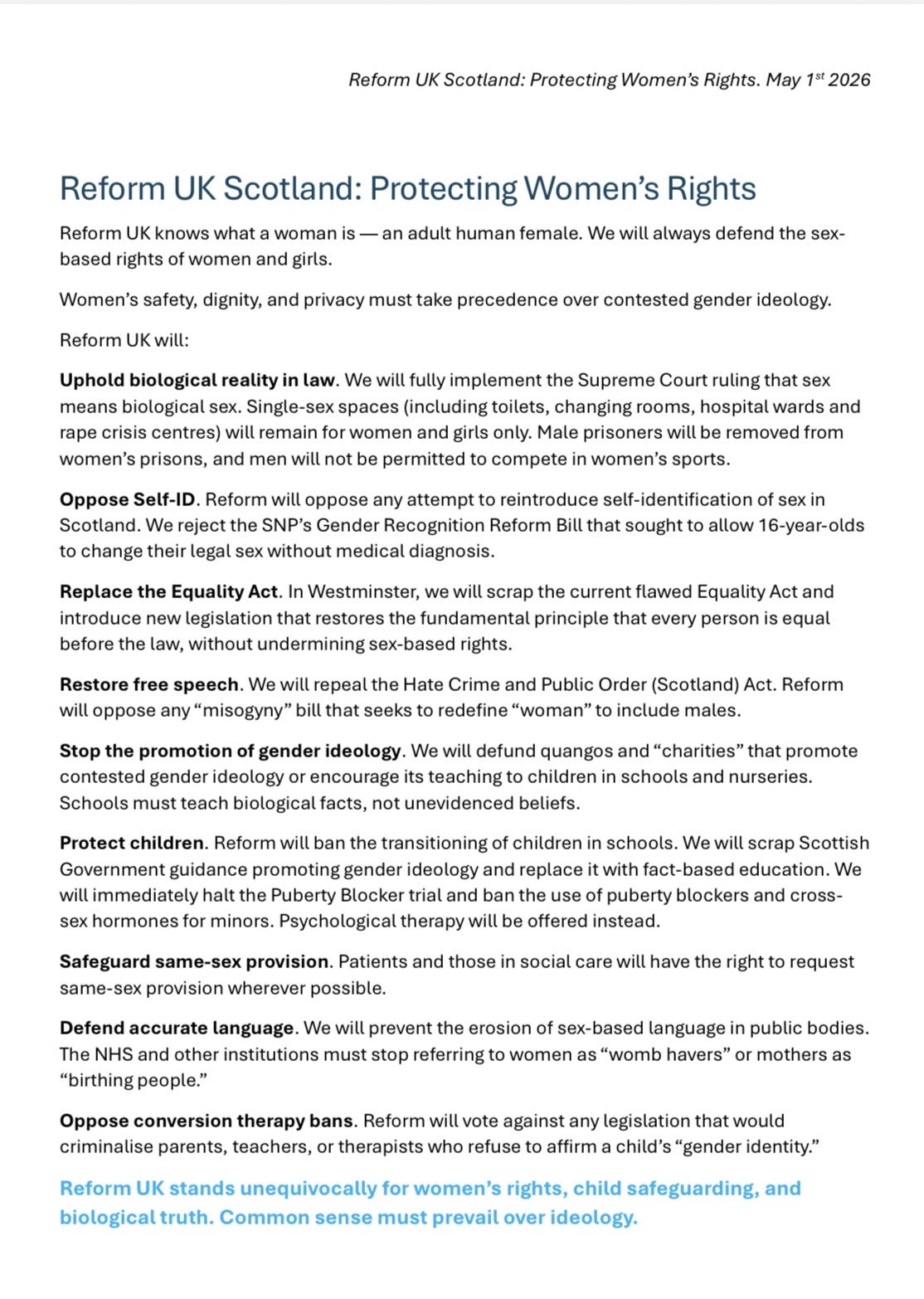
The Reform manifesto is light on specific policies for women (the word is only used once) but is critical of the SNP for not protecting women and girls and pursuing “woke policies” on gender.
Interesting proposals include shutting down quangos, including Education Scotland, and returning responsibility to the Scottish Government answerable to Holyrood, and repealing the Hate Crime and Public Order Act to restore freedom of speech and allowing police to focus on real crime.
Upholding the Supreme Court judgment is not mentioned at all and there is a lack of specific, actionable pledges on women’s rights and single-sex services, although we are relieved that the previously floated idea of repealing the Equality Act has been dropped!
STV Leaders Debate, 28 April 2026
Update 04 May 2026:
Women o’Scotland have posted the following statement from Reform on X:
Note on other parties and independent candidates:
There are many other smaller parties hoping for your vote in this election, some of whom are very supportive of women’s rights. Please do contact your candidates, especially those who are standing as an independent, and ask their views on women’s rights and implementing the Supreme Court judgment. Special mention goes to three former MSPs who are now standing as strong independent candidates: Fergus Ewing in Inverness and Nairn constituency, and Ash Regan and Jeremy Balfour who are both on the regional list for Edinburgh and Lothians East.
Summary of party positions on key issues:
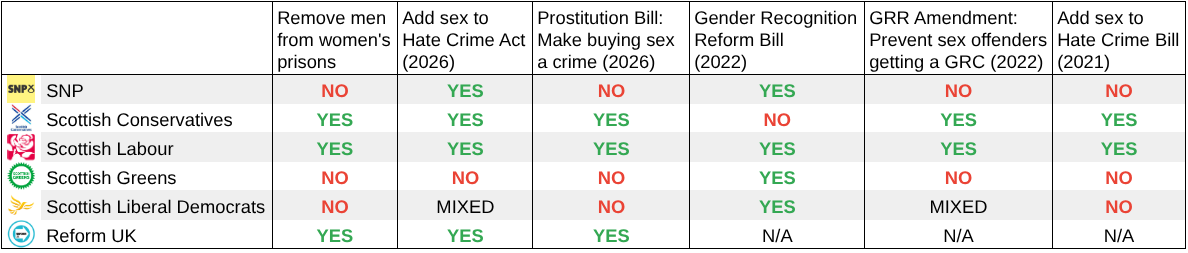
If any of your candidates have previously served as an MSP, check their voting record on key issues:
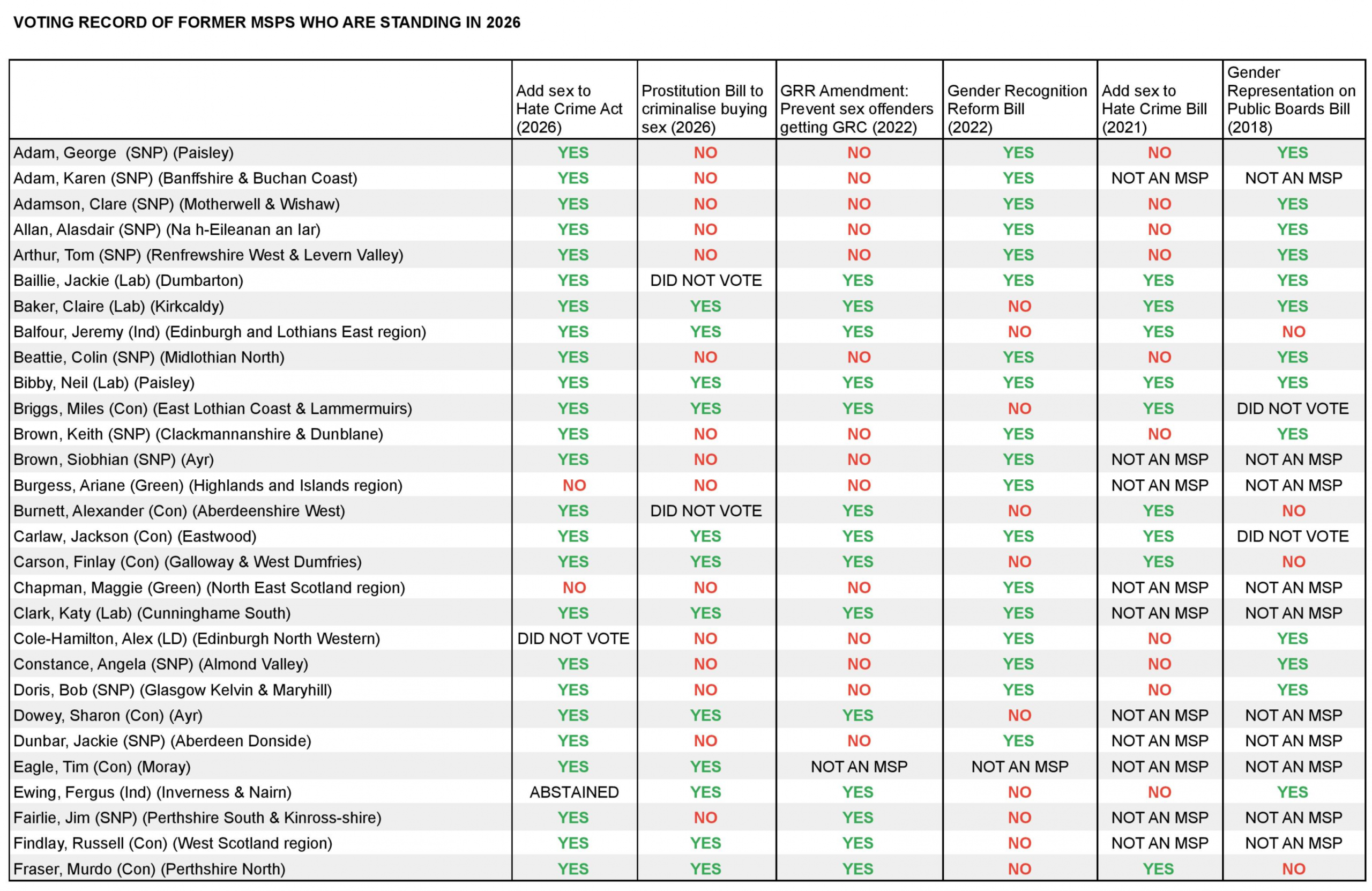
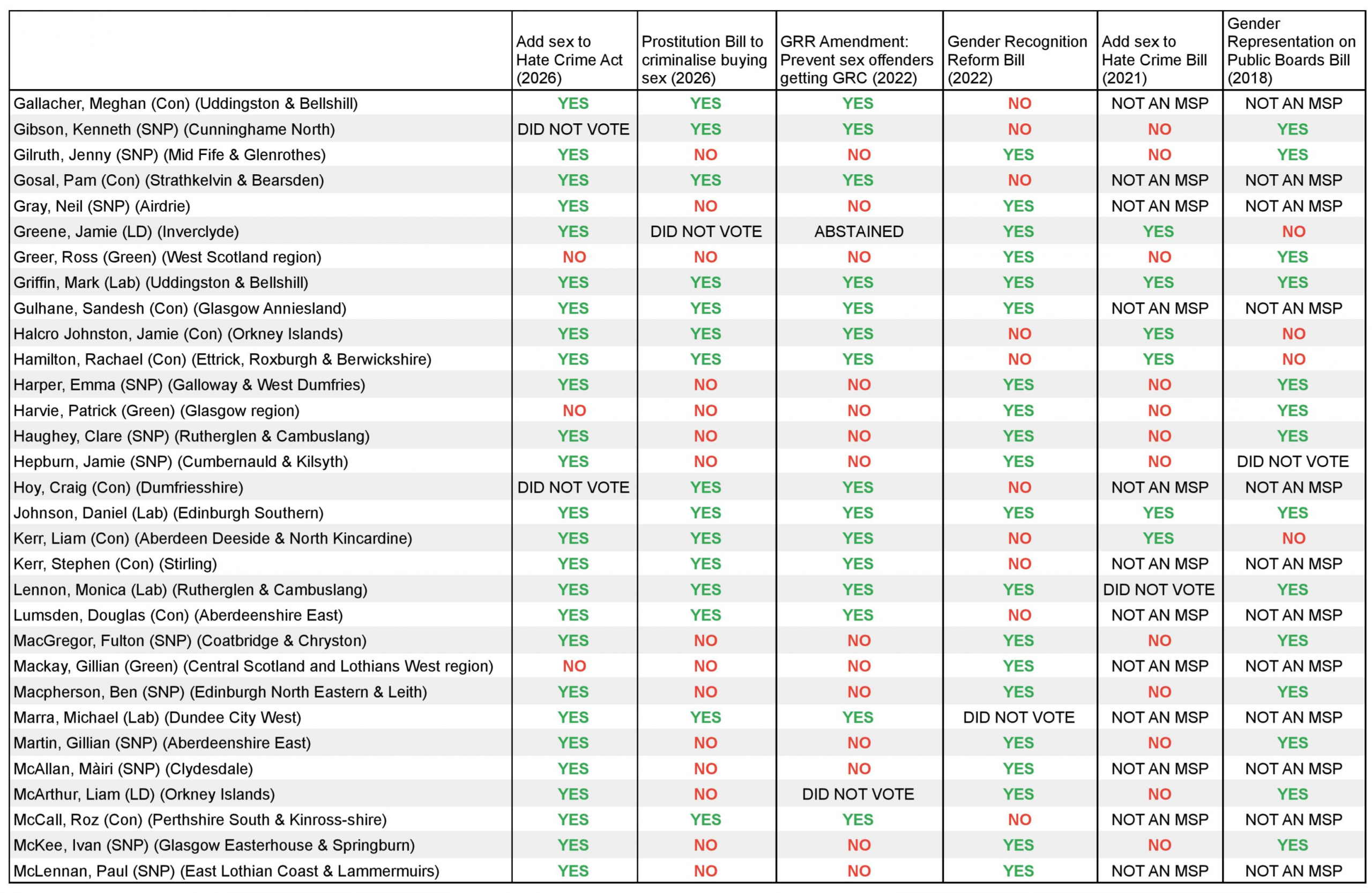
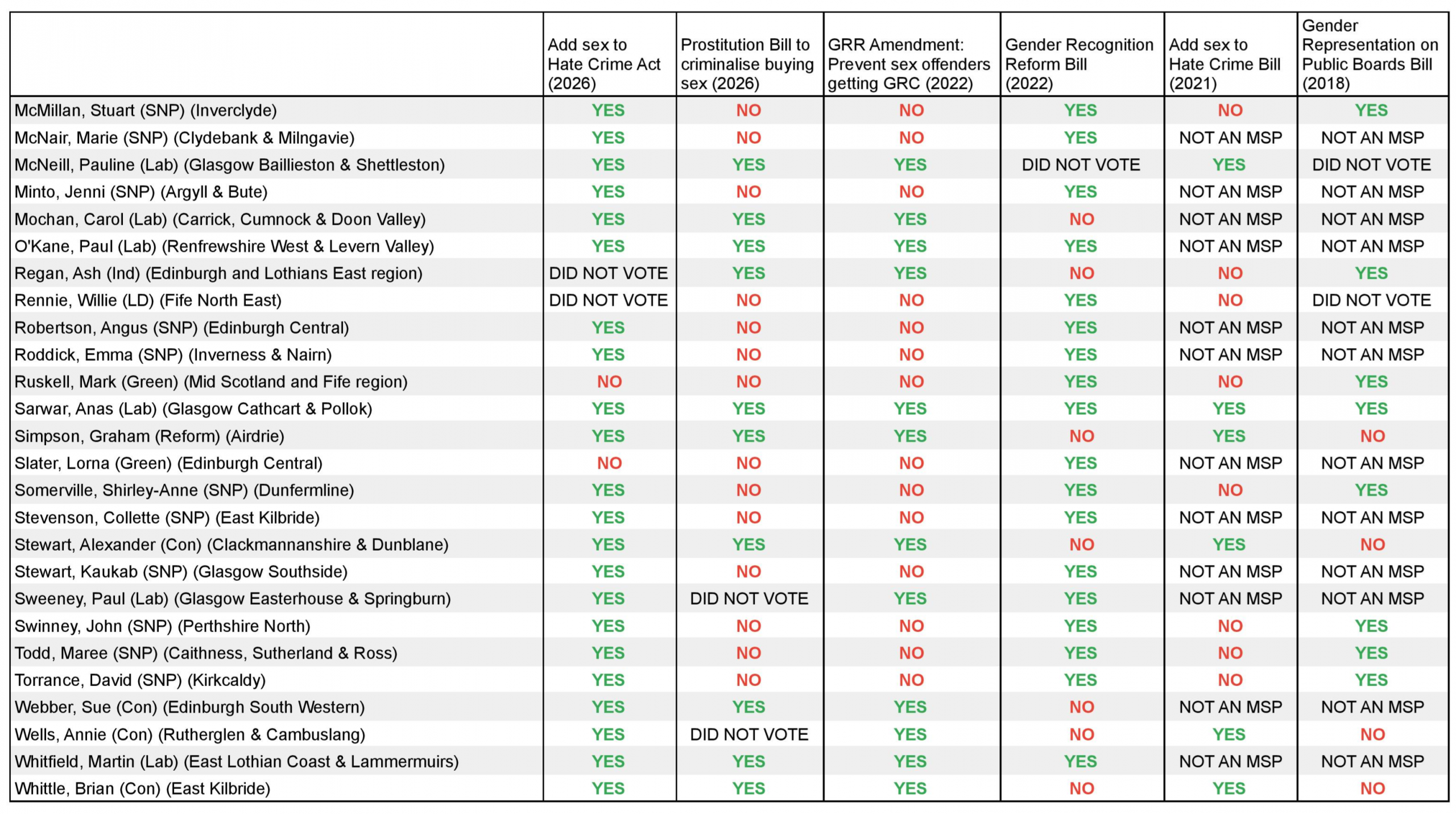
View/download as a PDF
Update 03 May 2026:
Now that we’ve looked at the manifestos, we thought we’d drill down a bit more into the constituencies and regions:
- Central Scotland and Lothians West
- Edinburgh and Lothians East
- Glasgow
- Highlands and Islands
- Mid Scotland and Fife
- North East Scotland
- South Scotland
- West Scotland
We have mainly drawn on the polling from YouGov and More In Common as they have looked at the constituencies. Other polls are available!
We have posted threads for each region and its constituencies on our X account, so have a look and see if anyone has added any other helpful information.